
The Role of Industrial Fans in Tunnel Environments
Index
Tunnels are enclosed spaces where air does not circulate easily on its own, making planned ventilation and exhaust essential. Industrial fans handle the exhaust of contaminated air and the supply of fresh air, helping maintain the work environment and ensure safety that can affect lives. This article explains the roles of fans, how they are used, and the key points for selection.
Role of Industrial Fans
in Tunnels
Industrial fans in tunnels handle ventilation, exhaust, and air circulation in enclosed spaces where natural air exchange with the outside is difficult. Their main role is to forcibly exhaust vehicle emissions and dust and replace them with fresh air.
In addition to preventing a drop in oxygen concentration and helping maintain visibility during work, they also help keep environmental conditions inside the tunnel consistent by reducing uneven heat and humidity. This is important for creating an environment where employees can work safely.
Environmental Characteristics
and Challenges
of Tunnels
Tunnels are structures surrounded by walls and ceilings, making them environments where air tends to stagnate. Natural ventilation cannot be relied on, and harmful substances such as dust and exhaust gases can easily accumulate inside.
These substances can fluctuate significantly in concentration and quickly cause poor visibility and respiratory strain. They can reduce employees’ concentration and judgment, ultimately affecting work quality and safety. In the worst case, they may also have adverse effects on workers’ health.
These effects are particularly pronounced in long tunnels and deep underground environments. Therefore, it is crucial for managers to understand the work environment and carry out ventilation in a planned manner to help prevent accidents and ensure stable site operations.
How Industrial Fans
Are Used
in Tunnels
In tunnels under construction, industrial fans are used to exhaust dust and exhaust gases generated during excavation work. They help maintain air conditions in the work area and ensure safe working conditions. During inspections and repair work, ventilation also improves visibility and breathing conditions, reducing work risks.
After the tunnel is completed, permanent equipment will be in operation, but during the construction period, temporary operation based on the work schedule is the main approach. Therefore, portable fans that are easy to move and install and can adjust the airflow direction are chosen as a way to deliver the necessary air to the work area accurately.
Types of Industrial Fans
Suitable
for Tunnels
Industrial fans with high airflow and stable airflow performance are necessary in tunnel environments. Portable types are suitable for temporary sites where work phases change, because they are easy to install and remove.
It is also important that the fan has a structure that is easy to place even in narrow spaces. By combining them with extension ducts, it is possible to supply and exhaust air as far as sections away from the work area.
From a safety standpoint, operational stability and structural robustness are necessary to help prevent accidents caused by tipping or vibration. In addition, products that can minimize the impact on surrounding equipment and work paths are an important consideration for safety management.
Key Points When Selecting
Tunnel
Industrial Fans
In tunnel construction and maintenance work, ventilation measures affect whether work can proceed and how the work schedule is planned, so selecting equipment in advance is key.
First, check whether it has the ventilation capacity to ensure worker safety and reduce the risk of work interruptions. Next, based on site conditions where installation space is limited, check whether the specifications allow for easy temporary installation and relocation.
As work locations change as the project progresses, the ability to change placement flexibly is also an important factor in the decision. At sites where long working hours are expected, stable operation and a low maintenance burden are important operational selection criteria. Choose with the goal of balancing safety management and work schedule management.
Explore Other
Industrial Fan Locations
The required performance and specifications for industrial fans differ depending on the installation location, not only in tunnels but also in other environments. By comparing different usage environments, you can identify the fans best suited to your site conditions. You can learn more about industrial fans by location here. See below.
Summary of Industrial Fans for Tunnels
Ensuring Life-Safety and Visibility in Enclosed Construction Sites
Industrial fans are a critical lifeline in tunnels to exhaust hazardous gases and dust while supplying fresh air. By utilizing portable blowers and flexible ducting, facilities can maintain clear visibility and ensure a safe, compliant work environment even in deep underground projects.
Our media independently researches and introduces recommended industrial fans based on specific needs like cooling, exhaust, and ventilation. Please check our 3 selected products below.
Three Recommended
Industrial Fan Products Chosen
by Cooling, Exhaust, and Ventilation
Industrial Fan Products Chosen
by Cooling, Exhaust, and Ventilation
Cooling
For Heat Stress Prevention
For Heat Stress Prevention
Gojoh
COOL FAN MIST
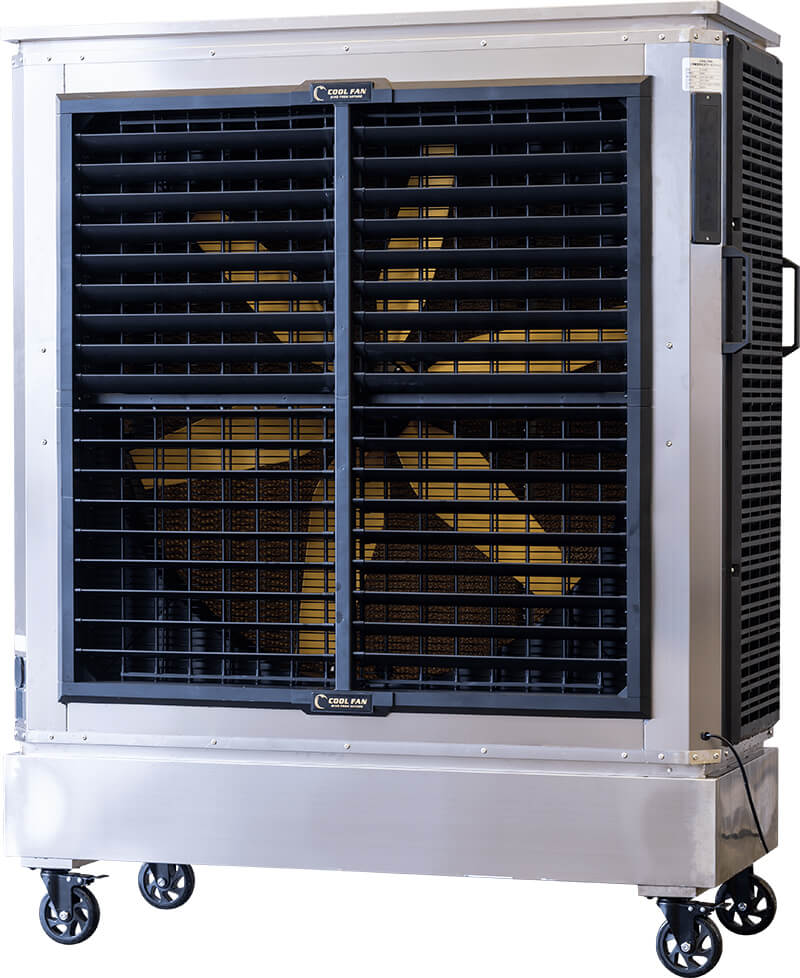
Source: Gojoh Official Website
(https://smile-fans.jp/products/cool-fan-mist/)
(https://smile-fans.jp/products/cool-fan-mist/)
6°C cooler than the surroundings (*1) for 8 hours. Powerful 25m reach + auto-swing to optimize your entire workspace.
Durable, hygienic stainless steel at a portable 210 lbs. Chemical-resistant and built for frequent relocation and long-term use.
| Type | Evaporative cooler |
|---|---|
| Dimensions (in/mm) |
Approx. 59.1" × 25.6" × 70.9" (1500 × 650 × 1800 mm) |
| Coverage Area |
Approx. 2,150–3,230 sq ft |
| Weight | Approx. 210 lb |
Exhaust
For Dust and Smoke Control in Confined Spaces
For Dust and Smoke Control in Confined Spaces
Allegro
8" COM-PAX-IAL Blower
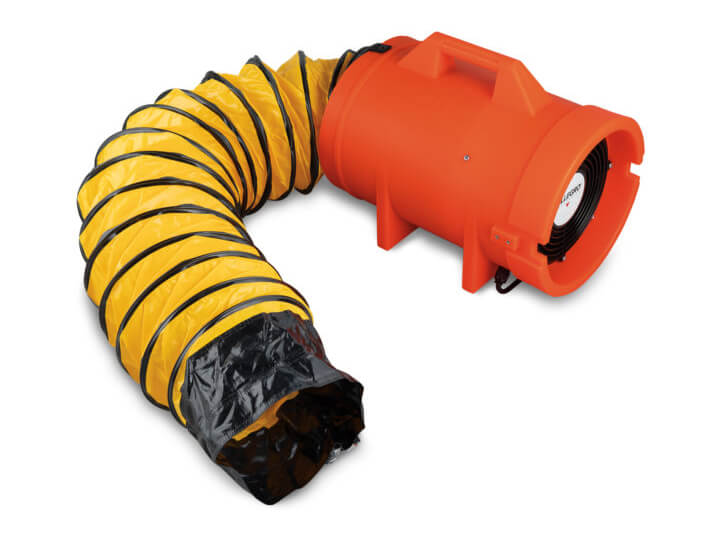
Source: Allegro Official Website
(https://www.allegrosafety.com/product/8-axial-ac-plastic-mini-pak-blower/)
(https://www.allegrosafety.com/product/8-axial-ac-plastic-mini-pak-blower/)
Rapidly exhausts dust/smoke replacing approx. 23.5m³ of air/min (*2). Lightweight polyethylene body is corrosion, UV, and chemical resistant for harsh environments.
Weighs under 19 lbs (lighter than steel) with integrated ducting. Easy to carry and set up, ensuring ventilation protocols are never skipped due to hassle.
| Type | Portable ventilation blower |
|---|---|
| Dimensions (in/mm) |
Approx. 17.5" × 11.3" × 13.5" (445 × 286 × 343 mm) |
| Coverage Area |
N/A |
| Weight | Approx. 19 lb |
Ventilation
For Stagnant Air and Moisture Control
For Stagnant Air and Moisture Control
DuctSox
ZOO FANS H series
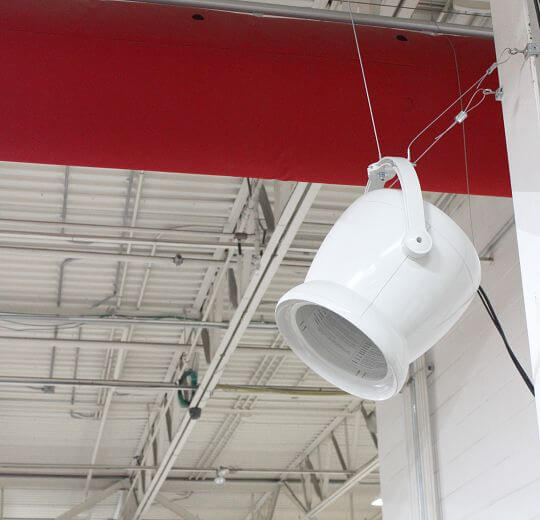
Source: DuctSox Official Website
(https://www.zoofans.com/our-company)
(https://www.zoofans.com/our-company)
Designed by spatial volume, not floor area. Creates a column of air mixing ceiling to floor to inhibit condensation, mold, and rust.
Includes one-touch mounting hardware. Low-cost installation even in warehouses where large HVLS fans won't fit.
| Type | Destratification Fan |
|---|---|
| Size (mm) | 445×391×551 (*3) |
| Coverage | 25 ft (*3) |
| Weight | 20 lb (*3) |
*1 Cool air temperature may vary depending on conditions such as ambient temperature and the surrounding environment. Because it uses water, use caution in areas where moisture is a concern.
*2 Basis and Calculation Method: Calculated based on the maximum airflow (Straight) of “791 CFM” for the “8" (20.3 cm) AXIAL AC PLASTIC MINI-PAK BLOWER (9532-15)” as listed in the catalog.
[Formula] 791 CFM × 0.02832 ≈ 22.4 m³/min (Converted as 1 CFM ≈ 0.02832 m³/min) | Source: Allegro Official Website [PDF] (https://www.allegrosafety.com/wp-content/uploads/2023/01/9532-15-9532-25-9532-15E-9532-25E-AC-Plastic-Blower.pdf)
*3 All specifications are for the H25-EC model.
*2 Basis and Calculation Method: Calculated based on the maximum airflow (Straight) of “791 CFM” for the “8" (20.3 cm) AXIAL AC PLASTIC MINI-PAK BLOWER (9532-15)” as listed in the catalog.
[Formula] 791 CFM × 0.02832 ≈ 22.4 m³/min (Converted as 1 CFM ≈ 0.02832 m³/min) | Source: Allegro Official Website [PDF] (https://www.allegrosafety.com/wp-content/uploads/2023/01/9532-15-9532-25-9532-15E-9532-25E-AC-Plastic-Blower.pdf)
*3 All specifications are for the H25-EC model.