
ProWork Fan Lab » Industrial Fans by Location
Industrial Fans by Location
Index
Industrial fans are used in a wide range of locations, including warehouses, factories, and tunnels. Because space layouts and airflow vary by installation environment, how these fans are used is not one-size-fits-all.
This article explains environmental characteristics and challenges by installation location across industrial fan types, and provides practical considerations to support selection.
What Does “Industrial Fans by Location” Mean?
The role and impact required of industrial fans depend on “where they are used,” not “which product it is.” Even with the same product, airflow and ventilation performance can vary depending on the installation location, and so can how it is used.
Therefore, rather than choosing by product type or structure, starting from the use location helps clarify the conditions and decision criteria to consider when selecting a fan.
Why Location Matters When Choosing
Industrial Fans
Because space layouts vary by location, industrial fan performance can vary as well. Conditions such as ceiling height, space size, and enclosure affect how air flows and how easily heat builds up.
In addition, the required roles of airflow and ventilation differ between people-focused work environments and environments with significant heat generated by operating equipment. Considering physical and operational conditions is essential for selecting the right fan type.
Industrial Fan Requirements Differ by Location
In warehouses, air tends to stagnate in large spaces, so the main role is improving the work environment through air circulation and ventilation. In factories, cooling and localized airflow are emphasized to address heat generated by equipment.
In tunnels, ventilation and exhaust in enclosed spaces are important to ensure safety.
Because air conditioning challenges and goals differ by location, selection should be based on each site’s application.
Warehouse Industrial Fan
Warehouses have high ceilings and large floor areas, so air tends to stagnate and temperature variations are common. Facility-wide air conditioning alone often struggles to deliver efficient cooling, and in summer, increased employee strain and heat stress prevention become key challenges.
Industrial fans support air circulation and ventilation, helping reduce temperature variations within warehouses. Effectiveness can vary depending on installation placement and operating approach, which is a key consideration for warehouses.
Factory Industrial Fan
Factories are sites where localized high-temperature areas can develop due to heat from production equipment and differences in work tasks across processes. In addition to ventilating the entire space, it is important to consider targeted airflow and cooling for specific areas. Industrial fans are important not only for ensuring employee comfort but also for maintaining conditions around equipment. How they are used should be adjusted based on the installation environment and operating conditions.
Tunnel Industrial Fan
Tunnels are highly enclosed spaces where natural ventilation cannot be relied on. Since exhaust gases, dust, and heat tend to accumulate, planned ventilation and exhaust are essential. Industrial fans are primarily used to ensure safety during work and emergencies and to control airflow. Operations must be tailored to work processes and installation conditions, so planning from the early stages is important.
Gymnasium Industrial Fan
Gymnasiums are large, enclosed spaces with high ceilings and few openings, so natural ventilation may be limited depending on the building design. Heat, humidity, and stale air build up quickly when gymnasiums fill with people, and standing moisture can even damage wooden floors over time. Industrial fans are used to circulate trapped air, support ventilation, and control humidity across whole spaces. Because occupants use areas directly below, fans must be selected with mounting, safety, and quiet operation in mind.
Key Points When SelectingIndustrial Fans
by Location
First, confirm the conditions of the installation space. Because size, ceiling height, and the placement of columns and equipment affect airflow reach and possible installation positions.
Then, determine whether the area is one where employees work continuously or one where equipment operation is the primary activity. Additionally, consider whether it will be used continuously for long periods or operated intermittently.
It is also important to consider not only installation safety measures but also how easy daily operation and maintenance will be, including inspections and cleaning.
Explore Industrial Fans by Location
If you are unsure which industrial fan to choose, it can help to start with the location type that best matches your environment. Understanding the characteristics of each installation location makes it easier to clarify the required role and priority conditions.
The articles below explain where industrial fans are used and what roles they play by location, so you can use them as a reference.
When selecting industrial fans, it is essential to first accurately understand the environmental characteristics and challenges of the location where the fan will be used, before comparing product specifications and performance. Understanding differences by installation location can help clarify your requirements. You can use this article as a reference for selecting industrial fans.
Three Recommended
Industrial Fan Products Chosen
by Cooling, Exhaust, and Ventilation
Industrial Fan Products Chosen
by Cooling, Exhaust, and Ventilation
Cooling
For Heat Stress Prevention
For Heat Stress Prevention
Gojoh
COOL FAN MIST
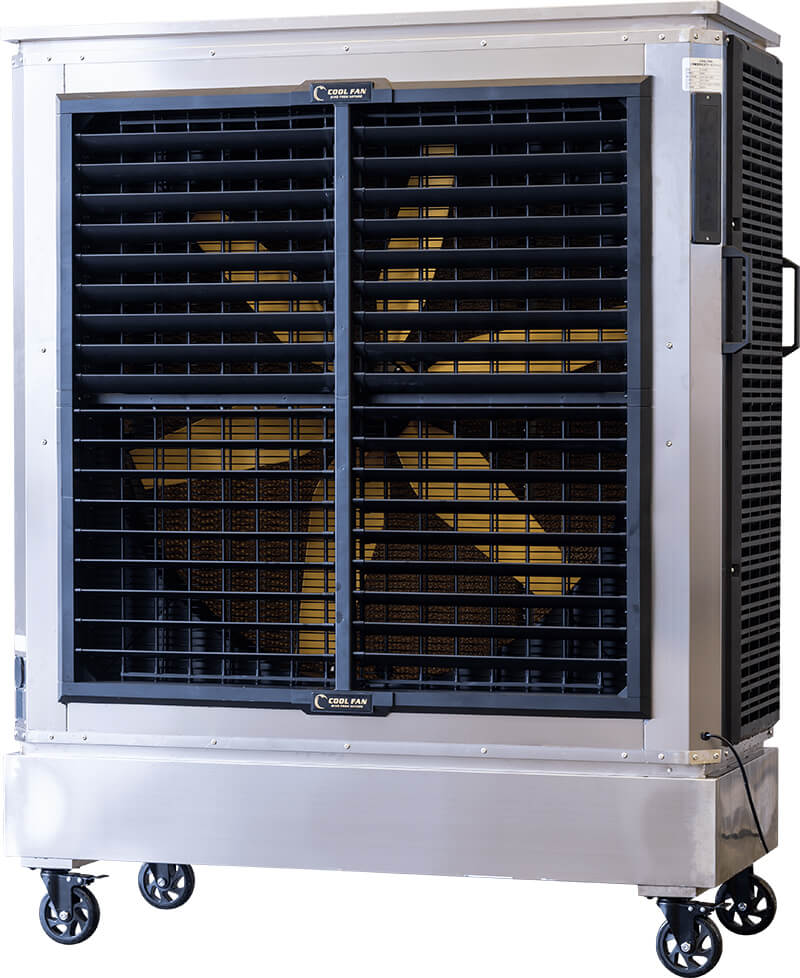
Source: Gojoh Official Website
(https://smile-fans.jp/products/cool-fan-mist/)
(https://smile-fans.jp/products/cool-fan-mist/)
6°C cooler than the surroundings (*1) for 8 hours. Powerful 25m reach + auto-swing to optimize your entire workspace.
Durable, hygienic stainless steel at a portable 210 lbs. Chemical-resistant and built for frequent relocation and long-term use.
| Type | Evaporative cooler |
|---|---|
| Dimensions (in/mm) |
Approx. 59.1" × 25.6" × 70.9" (1500 × 650 × 1800 mm) |
| Coverage Area |
Approx. 2,150–3,230 sq ft |
| Weight | Approx. 210 lb |
Exhaust
For Dust and Smoke Control in Confined Spaces
For Dust and Smoke Control in Confined Spaces
Allegro
8" COM-PAX-IAL Blower
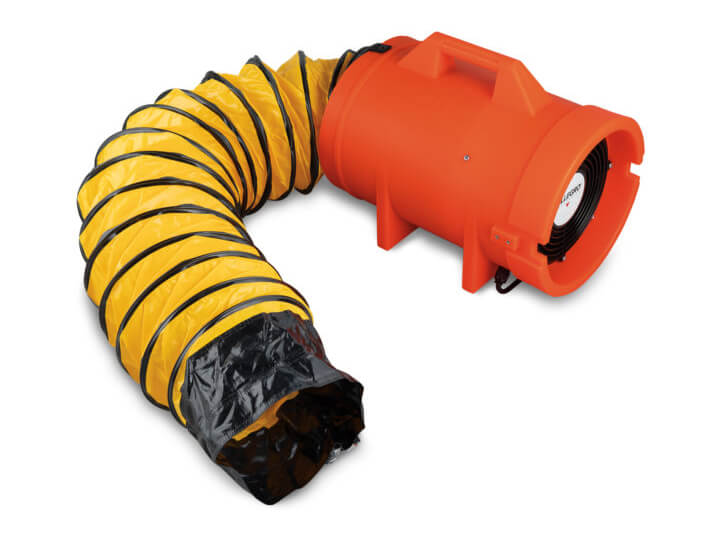
Source: Allegro Official Website
(https://www.allegrosafety.com/product/8-axial-ac-plastic-mini-pak-blower/)
(https://www.allegrosafety.com/product/8-axial-ac-plastic-mini-pak-blower/)
Rapidly exhausts dust/smoke replacing approx. 23.5m³ of air/min (*2). Lightweight polyethylene body is corrosion, UV, and chemical resistant for harsh environments.
Weighs under 19 lbs (lighter than steel) with integrated ducting. Easy to carry and set up, ensuring ventilation protocols are never skipped due to hassle.
| Type | Portable ventilation blower |
|---|---|
| Dimensions (in/mm) |
Approx. 17.5" × 11.3" × 13.5" (445 × 286 × 343 mm) |
| Coverage Area |
N/A |
| Weight | Approx. 19 lb |
Ventilation
For Stagnant Air and Moisture Control
For Stagnant Air and Moisture Control
DuctSox
ZOO FANS H series
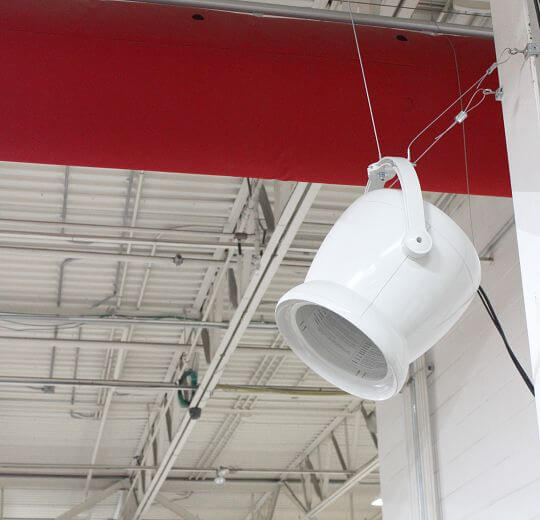
Source: DuctSox Official Website
(https://www.zoofans.com/our-company)
(https://www.zoofans.com/our-company)
Designed by spatial volume, not floor area. Creates a column of air mixing ceiling to floor to inhibit condensation, mold, and rust.
Includes one-touch mounting hardware. Low-cost installation even in warehouses where large HVLS fans won't fit.
| Type | Destratification Fan |
|---|---|
| Size (mm) | 445×391×551 (*3) |
| Coverage | 25 ft (*3) |
| Weight | 20 lb (*3) |
*1 Cool air temperature may vary depending on conditions such as ambient temperature and the surrounding environment. Because it uses water, use caution in areas where moisture is a concern.
*2 Basis and Calculation Method: Calculated based on the maximum airflow (Straight) of “791 CFM” for the “8" (20.3 cm) AXIAL AC PLASTIC MINI-PAK BLOWER (9532-15)” as listed in the catalog.
[Formula] 791 CFM × 0.02832 ≈ 22.4 m³/min (Converted as 1 CFM ≈ 0.02832 m³/min) | Source: Allegro Official Website [PDF] (https://www.allegrosafety.com/wp-content/uploads/2023/01/9532-15-9532-25-9532-15E-9532-25E-AC-Plastic-Blower.pdf)
*3 All specifications are for the H25-EC model.
*2 Basis and Calculation Method: Calculated based on the maximum airflow (Straight) of “791 CFM” for the “8" (20.3 cm) AXIAL AC PLASTIC MINI-PAK BLOWER (9532-15)” as listed in the catalog.
[Formula] 791 CFM × 0.02832 ≈ 22.4 m³/min (Converted as 1 CFM ≈ 0.02832 m³/min) | Source: Allegro Official Website [PDF] (https://www.allegrosafety.com/wp-content/uploads/2023/01/9532-15-9532-25-9532-15E-9532-25E-AC-Plastic-Blower.pdf)
*3 All specifications are for the H25-EC model.