
How Industrial Misting Fans Provide Localized Cooling
Index
An industrial misting fan is a cooling device that sprays water as a fine mist while blowing air, lowering the surrounding temperature through evaporative cooling. This product is used as a supplemental cooling method in indoor and outdoor environments such as factories, warehouses, and construction sites where installing air conditioning is difficult.
This article explains the basic mechanism and features of industrial misting fans.
What Is an Industrial Misting Fan?
It is a system that provides cooling by spraying water as a fine mist in addition to circulating air. The sprayed mist evaporates in the air, absorbing heat and lowering the surrounding air temperature while also improving perceived cooling.
Regular circulation fans are primarily designed to move air and do not lower the air temperature itself. In contrast, industrial misting fans can provide cooling while circulating air. Because they do not require large-scale air conditioning and can be installed relatively easily, they are chosen as a practical cooling method for industrial sites.
How Industrial Misting Fans
Provide Cooling
Cooling is achieved by spraying water as a fine mist and using the process of evaporation in the air. The fine water particles that are sprayed absorb heat from the surrounding air as they evaporate, lowering the air temperature. As a result, the felt temperature throughout the workspace decreases.
In low-humidity environments, water evaporates more easily, making the cooling effect easier to achieve. In contrast, higher humidity reduces evaporation, resulting in a milder cooling effect. Additionally, outdoors, airflow can cause the cooling effect to disperse more easily, while indoors, the cooling effect varies depending on ventilation conditions.
Typical Applications of
Industrial Misting Fans
In outdoor work sites, it is used for heat stress prevention in high-temperature environments during construction and loading operations. It is installed to direct airflow toward work areas exposed to direct sunlight, helping reduce the risk of heat-related illness.
In factories and warehouses where overall air conditioning is difficult, it is used for localized cooling in specific work lines or areas where people gather. A key feature is that cooling can be limited to the areas where it is needed.
It is also used as a temporary cooling method in places such as event venues and temporary tents where permanent equipment is difficult to install.
Advantages and Considerations of
Industrial Misting Fans
One advantage is that the cooling effect can be felt soon after operation begins because mist is sprayed. It can also be used only where needed, making it suitable for localized cooling as a supplement to overall air conditioning. Compared with air conditioning systems that cool large areas, its superior energy efficiency is also a key advantage.
On the other hand, because it uses water, potential concerns include wet floors, rust on metal parts, and effects on surrounding equipment and work environments. Additionally, in environments with high humidity or insufficient ventilation, sufficient cooling may not be achieved, so operation must take the installation environment and usage conditions into account.
Key Points When Selecting
an Industrial Misting Fan
When selecting a product, several points must be considered based on the usage environment and operating conditions.
First, check whether the installation site is indoors or outdoors, and assess compatibility with the surrounding environment and ventilation conditions. Next, consider whether the water supply should be tank-based or directly connected to the water line, and confirm whether a stable supply of usable water can be secured.
Furthermore, clarify the cooling range and determine whether to cool the entire space or to use spot cooling for employees and areas around equipment. Finally, it is important to check whether installation and operation can be carried out smoothly, taking into account the workflow and equipment layout.
Explore Other
Industrial Fan Types
There are industrial fans for different applications and installation environments, including those used primarily for ventilation and those specialized for air circulation. By comparing cooling methods and objectives, it becomes easier to select equipment suited to the site. If you are looking for industrial fans other than industrial misting fans, see below.
Summary of Industrial Misting Fans
Cost-Effective Evaporative Cooling for Open Environments
Industrial misting fans provide a practical solution for immediate spot cooling in areas where HVAC installation is difficult. They offer superior energy efficiency for heat stress prevention, provided that ambient humidity and potential moisture on floors or equipment are managed.
Our media independently researches and introduces recommended industrial fans based on specific needs like cooling, exhaust, and ventilation. Please check our 3 selected products below.
Three Recommended
Industrial Fan Products Chosen
by Cooling, Exhaust, and Ventilation
Industrial Fan Products Chosen
by Cooling, Exhaust, and Ventilation
Cooling
For Heat Stress Prevention
For Heat Stress Prevention
Gojoh
COOL FAN MIST
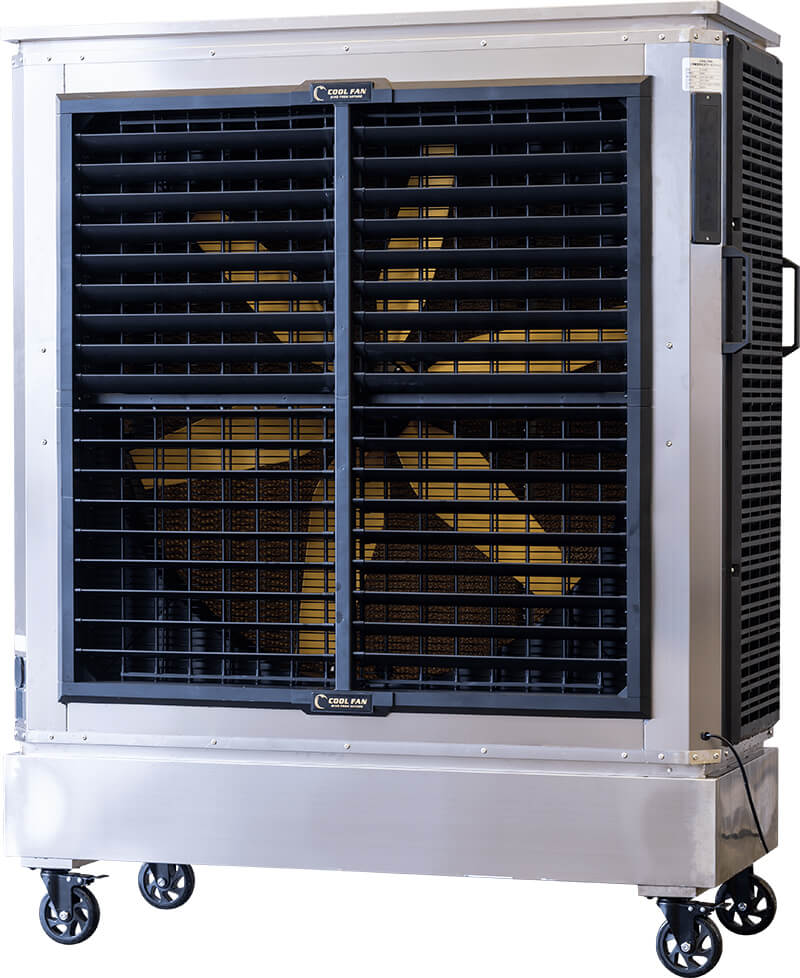
Source: Gojoh Official Website
(https://smile-fans.jp/products/cool-fan-mist/)
(https://smile-fans.jp/products/cool-fan-mist/)
6°C cooler than the surroundings (*1) for 8 hours. Powerful 25m reach + auto-swing to optimize your entire workspace.
Durable, hygienic stainless steel at a portable 210 lbs. Chemical-resistant and built for frequent relocation and long-term use.
| Type | Evaporative cooler |
|---|---|
| Dimensions (in/mm) |
Approx. 59.1" × 25.6" × 70.9" (1500 × 650 × 1800 mm) |
| Coverage Area |
Approx. 2,150–3,230 sq ft |
| Weight | Approx. 210 lb |
Exhaust
For Dust and Smoke Control in Confined Spaces
For Dust and Smoke Control in Confined Spaces
Allegro
8" COM-PAX-IAL Blower
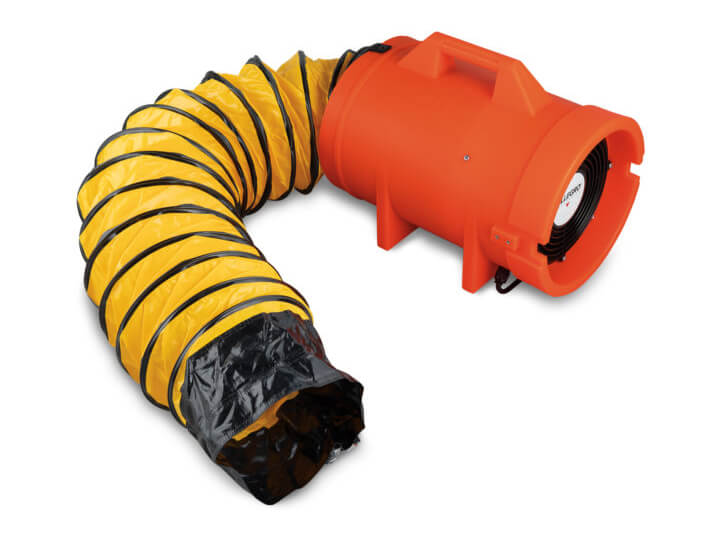
Source: Allegro Official Website
(https://www.allegrosafety.com/product/8-axial-ac-plastic-mini-pak-blower/)
(https://www.allegrosafety.com/product/8-axial-ac-plastic-mini-pak-blower/)
Rapidly exhausts dust/smoke replacing approx. 23.5m³ of air/min (*2). Lightweight polyethylene body is corrosion, UV, and chemical resistant for harsh environments.
Weighs under 19 lbs (lighter than steel) with integrated ducting. Easy to carry and set up, ensuring ventilation protocols are never skipped due to hassle.
| Type | Portable ventilation blower |
|---|---|
| Dimensions (in/mm) |
Approx. 17.5" × 11.3" × 13.5" (445 × 286 × 343 mm) |
| Coverage Area |
N/A |
| Weight | Approx. 19 lb |
Ventilation
For Stagnant Air and Moisture Control
For Stagnant Air and Moisture Control
DuctSox
ZOO FANS H series
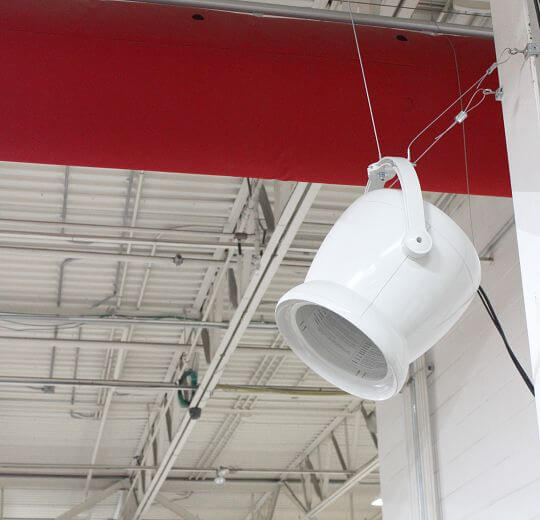
Source: DuctSox Official Website
(https://www.zoofans.com/our-company)
(https://www.zoofans.com/our-company)
Designed by spatial volume, not floor area. Creates a column of air mixing ceiling to floor to inhibit condensation, mold, and rust.
Includes one-touch mounting hardware. Low-cost installation even in warehouses where large HVLS fans won't fit.
| Type | Destratification Fan |
|---|---|
| Size (mm) | 445×391×551 (*3) |
| Coverage | 25 ft (*3) |
| Weight | 20 lb (*3) |
*1 Cool air temperature may vary depending on conditions such as ambient temperature and the surrounding environment. Because it uses water, use caution in areas where moisture is a concern.
*2 Basis and Calculation Method: Calculated based on the maximum airflow (Straight) of “791 CFM” for the “8" (20.3 cm) AXIAL AC PLASTIC MINI-PAK BLOWER (9532-15)” as listed in the catalog.
[Formula] 791 CFM × 0.02832 ≈ 22.4 m³/min (Converted as 1 CFM ≈ 0.02832 m³/min) | Source: Allegro Official Website [PDF] (https://www.allegrosafety.com/wp-content/uploads/2023/01/9532-15-9532-25-9532-15E-9532-25E-AC-Plastic-Blower.pdf)
*3 All specifications are for the H25-EC model.
*2 Basis and Calculation Method: Calculated based on the maximum airflow (Straight) of “791 CFM” for the “8" (20.3 cm) AXIAL AC PLASTIC MINI-PAK BLOWER (9532-15)” as listed in the catalog.
[Formula] 791 CFM × 0.02832 ≈ 22.4 m³/min (Converted as 1 CFM ≈ 0.02832 m³/min) | Source: Allegro Official Website [PDF] (https://www.allegrosafety.com/wp-content/uploads/2023/01/9532-15-9532-25-9532-15E-9532-25E-AC-Plastic-Blower.pdf)
*3 All specifications are for the H25-EC model.