
ProWork Fan Lab » Industrial Heat Stress Prevention: Basics & Countermeasures » Heat Stress Prevention in Warehouses Using Industrial Fans
Heat Stress Prevention in Warehouses Using Industrial Fans
Index
In warehouses, high-temperature conditions tend to become the norm, especially during summer, significantly affecting worker safety and productivity. Due to structural constraints, air conditioning alone is often not enough, and measures suited to the site are needed. This article addresses warehouse-specific challenges and explains the use of industrial fans for heat stress prevention.
Why Heat Stress Is a Problem in Warehouses
Heat Stress Risks in Warehouse Environments
Warehouses have high ceilings where heat tends to accumulate, and insufficient ventilation can easily cause indoor temperatures to rise.
Heat stress caused by hot conditions is a significant factor that greatly reduces workers’ attention and judgment. Reduced performance not only hinders work efficiency but also increases the risk of serious workplace accidents, such as forklift operating errors and falls.
Key Challenges of
Heat Stress Prevention
in Warehouses
High Ceilings and Air Stagnation
High-ceiling warehouses are structured with a large interior volume, making it easy for warm air to gather near the ceiling. The upper layer of air is difficult to remove through natural ventilation, causing heat to become trapped. Stagnant air circulation and prolonged high temperatures throughout the warehouse are factors that make heat stress prevention more difficult.
Limited Effectiveness of Air Conditioning
Warehouse interiors make it difficult for cool air from air conditioning to circulate throughout the space. Because cool air tends to remain in the lower layers, the temperature difference from the warm air trapped near the ceiling cannot be reduced. Lowering the thermostat setting does not easily improve perceived temperature and only leads to higher energy costs.
Wide Areas and Temperature Variation
In large warehouses, work areas are spread out, and differences in ceiling structure and equipment layout lead to variations in how heat builds up. Perceived temperature varies by work location, with some areas experiencing consistently high temperatures. Such temperature variations contribute to uneven workloads and increase the risk of heat stress.
Role of Fans
in Warehouse
Heat Stress Prevention
How Industrial Fans
Help Reduce Heat Stress
Industrial fans are devices that forcibly circulate air within the warehouse and disperse warm air trapped near the ceiling to lower levels. Airflow breaks up layers of air, making temperature distribution more uniform. The added effect of lowering perceived temperature through airflow also makes them effective for easing high-temperature conditions in the warehouse.
Fans vs. Air Conditioning
in Warehouse Environments
Unlike air conditioning, which generates cool air, this equipment lowers perceived temperature through airflow. It does not lower temperature or humidity, but it promotes air circulation by moving trapped warm air and helps keep the work environment comfortable.
When used together with air conditioning, it helps improve cooling efficiency while supporting practical heat stress prevention.
Types of Fans Used
for Warehouse
Heat Stress Prevention
Evaporative Cooling Fans
This method cools the surrounding air by using the latent heat of water evaporation. In dry areas or warehouses with adequate ventilation, it helps reduce perceived temperature when combined with airflow. On the other hand, because cooling performance is affected by humidity conditions, it is essential to check the usage environment before installation.
HVLS Fans
It is characterized by generating a large volume of airflow at low rotational speeds, making it suitable for high-ceiling warehouses. It creates gentle airflow over a wide area, mixing the warm air near the ceiling. This type of industrial fan is effective in reducing temperature variations and preventing heat buildup by promoting air circulation.
Points to Consider When Selecting
a Warehouse
Heat Stress Prevention Fan
Warehouse Size and Layout
The appropriate type of industrial fan and installation method vary depending on the warehouse floor area, ceiling height, and the arrangement of columns and equipment. After understanding the overall structure of the space, whether the fan can move air effectively is a key point in selection.
Safety and Operational Requirements
Depending on the installation location and operating conditions, it is necessary to consider the impact on equipment and traffic flow. An operational design is required that ensures worker safety while not interfering with daily operations or logistics work.
Maintenance and Long-Term Operation
As equipment intended for long-term use, it is essential to check whether it has a structure that allows for easy inspection and cleaning. To maintain stable cooling performance, installation should be planned with regular maintenance in mind.
Summary: Choosing the Right Fan
for Warehouse
Heat Stress Prevention
Warehouses are structurally prone to heat buildup, making them challenging environments for heat stress prevention. Industrial fans improve air circulation and function effectively as a practical countermeasure. It is important to select an industrial fan suited to your operating environment, taking into account the warehouse structure and operating conditions.
Summary: Heat Stress Prevention for Warehouses
Protecting Workers and Efficiency in Structural Heat Traps
Industrial fans are a critical investment for warehouses to mitigate heat stress risks where standard HVAC falls short. By breaking up air stratification and improving circulation, facilities can ensure worker safety and maintain stable operational performance during peak summer temperatures.
Our media independently researches and introduces recommended industrial fans based on specific needs like cooling, exhaust, and ventilation. Please check our 3 selected products below.
Three Recommended
Industrial Fan Products Chosen
by Cooling, Exhaust, and Ventilation
Industrial Fan Products Chosen
by Cooling, Exhaust, and Ventilation
Cooling
For Heat Stress Prevention
For Heat Stress Prevention
Gojoh
COOL FAN MIST
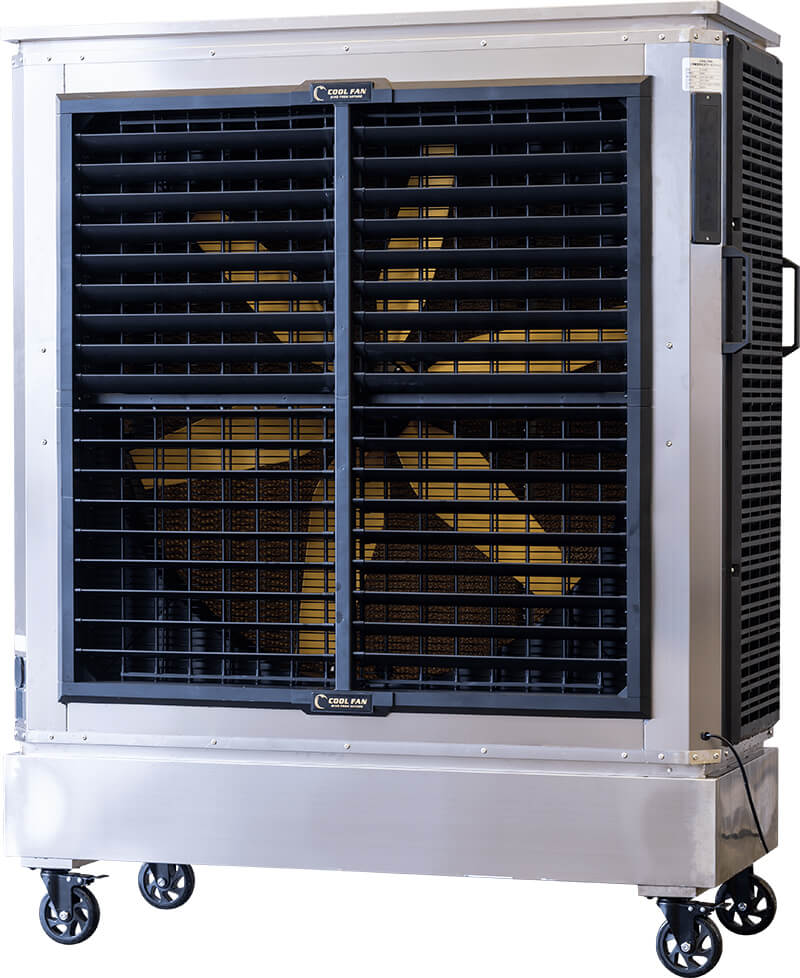
Source: Gojoh Official Website
(https://smile-fans.jp/products/cool-fan-mist/)
(https://smile-fans.jp/products/cool-fan-mist/)
6°C cooler than the surroundings (*1) for 8 hours. Powerful 25m reach + auto-swing to optimize your entire workspace.
Durable, hygienic stainless steel at a portable 210 lbs. Chemical-resistant and built for frequent relocation and long-term use.
| Type | Evaporative cooler |
|---|---|
| Dimensions (in/mm) |
Approx. 59.1" × 25.6" × 70.9" (1500 × 650 × 1800 mm) |
| Coverage Area |
Approx. 2,150–3,230 sq ft |
| Weight | Approx. 210 lb |
Exhaust
For Dust and Smoke Control in Confined Spaces
For Dust and Smoke Control in Confined Spaces
Allegro
8" COM-PAX-IAL Blower
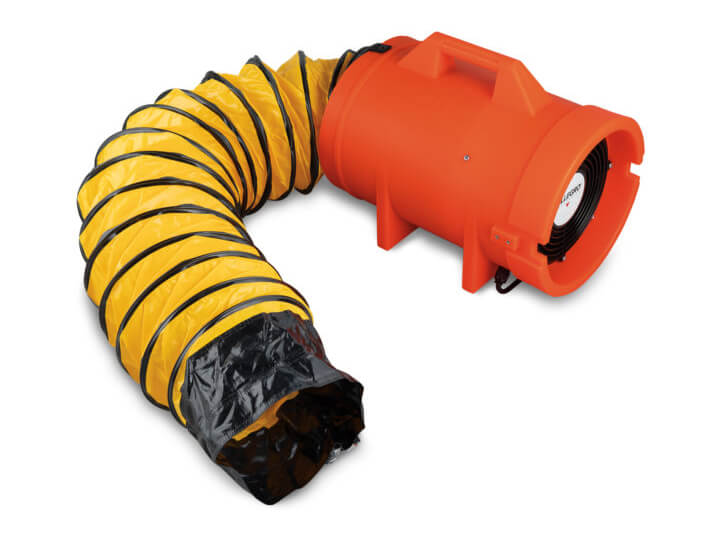
Source: Allegro Official Website
(https://www.allegrosafety.com/product/8-axial-ac-plastic-mini-pak-blower/)
(https://www.allegrosafety.com/product/8-axial-ac-plastic-mini-pak-blower/)
Rapidly exhausts dust/smoke replacing approx. 23.5m³ of air/min (*2). Lightweight polyethylene body is corrosion, UV, and chemical resistant for harsh environments.
Weighs under 19 lbs (lighter than steel) with integrated ducting. Easy to carry and set up, ensuring ventilation protocols are never skipped due to hassle.
| Type | Portable ventilation blower |
|---|---|
| Dimensions (in/mm) |
Approx. 17.5" × 11.3" × 13.5" (445 × 286 × 343 mm) |
| Coverage Area |
N/A |
| Weight | Approx. 19 lb |
Ventilation
For Stagnant Air and Moisture Control
For Stagnant Air and Moisture Control
DuctSox
ZOO FANS H series
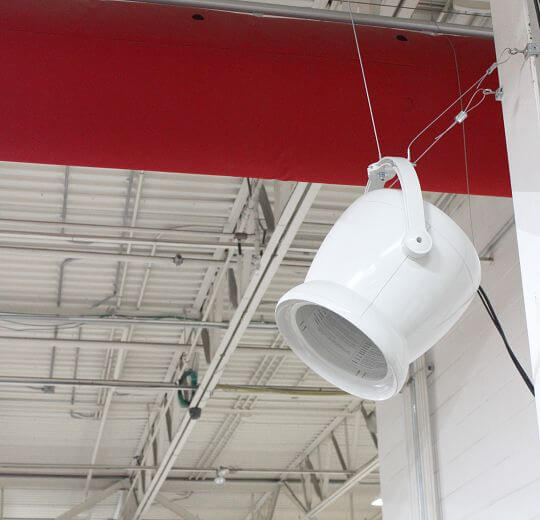
Source: DuctSox Official Website
(https://www.zoofans.com/our-company)
(https://www.zoofans.com/our-company)
Designed by spatial volume, not floor area. Creates a column of air mixing ceiling to floor to inhibit condensation, mold, and rust.
Includes one-touch mounting hardware. Low-cost installation even in warehouses where large HVLS fans won't fit.
| Type | Destratification Fan |
|---|---|
| Size (mm) | 445×391×551 (*3) |
| Coverage | 25 ft (*3) |
| Weight | 20 lb (*3) |
*1 Cool air temperature may vary depending on conditions such as ambient temperature and the surrounding environment. Because it uses water, use caution in areas where moisture is a concern.
*2 Basis and Calculation Method: Calculated based on the maximum airflow (Straight) of “791 CFM” for the “8" (20.3 cm) AXIAL AC PLASTIC MINI-PAK BLOWER (9532-15)” as listed in the catalog.
[Formula] 791 CFM × 0.02832 ≈ 22.4 m³/min (Converted as 1 CFM ≈ 0.02832 m³/min) | Source: Allegro Official Website [PDF] (https://www.allegrosafety.com/wp-content/uploads/2023/01/9532-15-9532-25-9532-15E-9532-25E-AC-Plastic-Blower.pdf)
*3 All specifications are for the H25-EC model.
*2 Basis and Calculation Method: Calculated based on the maximum airflow (Straight) of “791 CFM” for the “8" (20.3 cm) AXIAL AC PLASTIC MINI-PAK BLOWER (9532-15)” as listed in the catalog.
[Formula] 791 CFM × 0.02832 ≈ 22.4 m³/min (Converted as 1 CFM ≈ 0.02832 m³/min) | Source: Allegro Official Website [PDF] (https://www.allegrosafety.com/wp-content/uploads/2023/01/9532-15-9532-25-9532-15E-9532-25E-AC-Plastic-Blower.pdf)
*3 All specifications are for the H25-EC model.