
The Role of Industrial Fans in Factory Environments
Index
Heat generated by machinery and stagnant air in factories and manufacturing sites are issues that can affect productivity and equipment operation.
In large spaces, air conditioning alone is often not enough, making it essential to optimize the environment with industrial fans that provide powerful airflow and ventilation. This article explains the role of fans in stabilizing factory environments and the importance of selecting the right one.
Role of Industrial Fans in Factories
The role of industrial fans is not only to help manage air quality through airflow and ventilation, but also to improve the efficiency of existing air conditioning systems. Circulating air around machine heat and radiant heat sources helps prevent heat buildup and reduce the risk of equipment shutdowns and product defects. At the same time, it also helps prevent condensation and mold, supporting quality control.
At sites where dust and gas are generated, fans are used to exhaust contaminated air. Proper airflow control is essential to support occupational health and safety and the stable operation of production lines.
Environmental Characteristics and Challenges
of Factories
Factories have high ceilings and large spaces, so even with overall air conditioning, cooled or heated air tends not to stay in work areas, making them prone to temperature stratification, in which heat accumulates near the ceiling. As a result, more energy is consumed than necessary.
The complex arrangement of large machinery can obstruct airflow, causing localized high temperatures and dust buildup around heat sources. Uneven temperature and air conditions can pose health risks to employees and lead to thermal runaway in precision equipment, resulting in production losses.
Rather than relying solely on overall air conditioning, it is essential to implement localized measures based on the load conditions in each area.
How Industrial Fans Are Used in Factories
The key is to use different fans depending on the purpose of each area. In spaces with high ceilings, circulating trapped hot air helps reduce temperature differences between upper and lower areas and lower air conditioning costs. On manufacturing lines, targeted cooling helps lower the perceived temperature, helping prevent heat stress and accidents among employees.
Near heat sources, exhaust fans are used to vent heat and help prevent equipment overheating. In processes such as welding, harmful fumes are removed through local exhaust to control their spread.
Managing airflow and ventilation is also essential for reducing air conditioning loads and improving overall factory safety and efficiency.
Types of Industrial Fans Suitable
for Factories
Depending on the application, industrial fans can be broadly categorized into types for airflow that promotes high-volume circulation, ventilation to replace indoor air, and exhaust to remove pollutants. Installation configurations also vary, including wall-mounted, portable, and ceiling-suspended models.
For creating airflow over a wide area, large fans that offer strong energy efficiency and generate a high air volume at low speeds are suitable, while high-static-pressure types are better for duct exhaust with resistance in the ducting and for targeted localized cooling.
It is important to select fans with the appropriate airflow and pressure characteristics based on the factory layout and the issues to be addressed, such as heat stress prevention, ventilation, and energy savings.
Key Points When Selecting Factory
Industrial Fans
When selecting factory fans, it is important to optimize both the load conditions of the installation environment and operating costs.
First, clarify the operating conditions, such as the size of the target area and whether heat sources or dust are present. In harsh environments with high temperatures, humidity, and heavy dust, models with high durability and dust- and water-resistant performance are essential.
In factories that operate for long hours, it is essential to consider not only the initial cost but also the total cost of ownership (TCO), including the energy-saving benefits of high-efficiency motors and ease of maintenance.
Taking a comprehensive view of safety, durability, and cost-effectiveness is key to stable long-term operation.
Explore Other
Industrial Fan Locations
Industrial fans are used not only on factory manufacturing floors but also in a wide range of locations, including warehouses, distribution centers, and commercial facilities. For more information on how to choose the right fans based on the characteristics of each environment, their roles, and the specific benefits of using them in different facilities, see the articles below.
Summary of Industrial Fans for Factories
Stabilizing Production and Safety through Precision Airflow Control
Industrial fans are essential for factories to neutralize machine heat and remove airborne pollutants. By strategically combining high-volume circulation with targeted exhaust, facilities can prevent equipment overheating and ensure a safe, productive environment for employees.
Our media independently researches and introduces recommended industrial fans based on specific needs like cooling, exhaust, and ventilation. Please check our 3 selected products below.
Three Recommended
Industrial Fan Products Chosen
by Cooling, Exhaust, and Ventilation
Industrial Fan Products Chosen
by Cooling, Exhaust, and Ventilation
Cooling
For Heat Stress Prevention
For Heat Stress Prevention
Gojoh
COOL FAN MIST
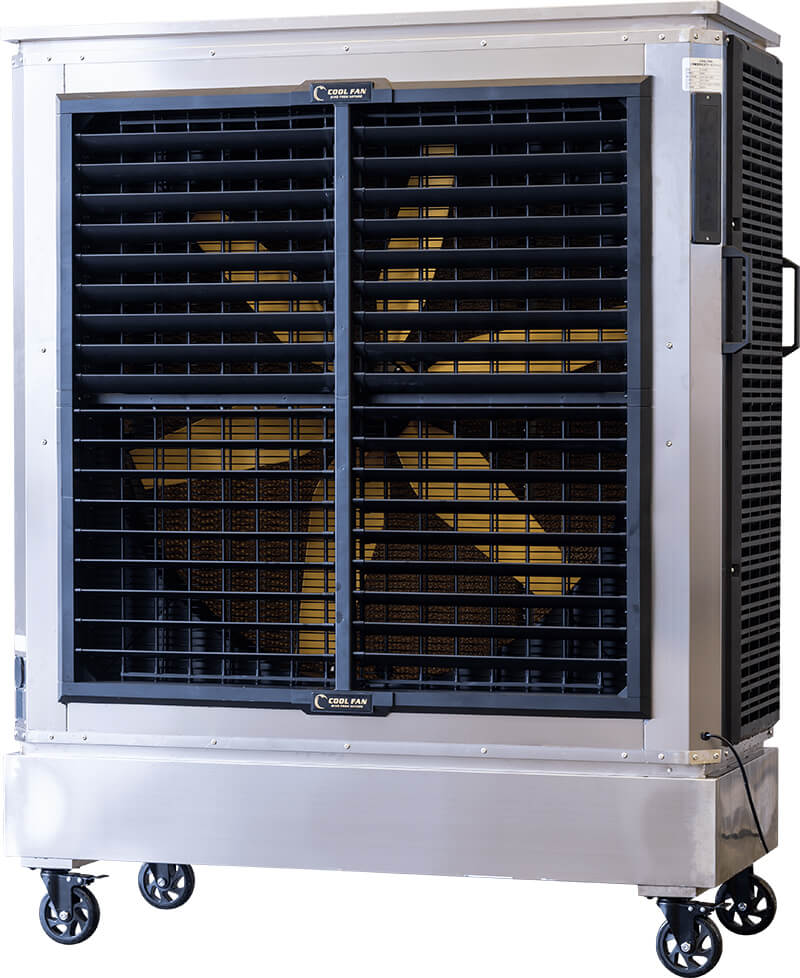
Source: Gojoh Official Website
(https://smile-fans.jp/products/cool-fan-mist/)
(https://smile-fans.jp/products/cool-fan-mist/)
6°C cooler than the surroundings (*1) for 8 hours. Powerful 25m reach + auto-swing to optimize your entire workspace.
Durable, hygienic stainless steel at a portable 210 lbs. Chemical-resistant and built for frequent relocation and long-term use.
| Type | Evaporative cooler |
|---|---|
| Dimensions (in/mm) |
Approx. 59.1" × 25.6" × 70.9" (1500 × 650 × 1800 mm) |
| Coverage Area |
Approx. 2,150–3,230 sq ft |
| Weight | Approx. 210 lb |
Exhaust
For Dust and Smoke Control in Confined Spaces
For Dust and Smoke Control in Confined Spaces
Allegro
8" COM-PAX-IAL Blower
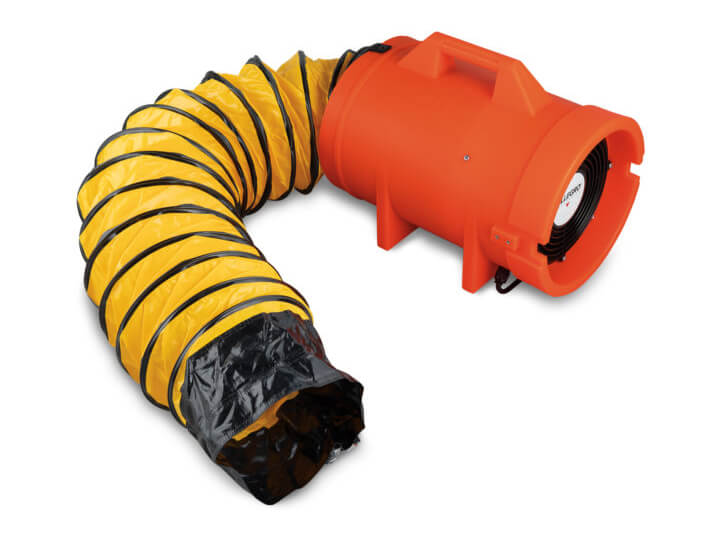
Source: Allegro Official Website
(https://www.allegrosafety.com/product/8-axial-ac-plastic-mini-pak-blower/)
(https://www.allegrosafety.com/product/8-axial-ac-plastic-mini-pak-blower/)
Rapidly exhausts dust/smoke replacing approx. 23.5m³ of air/min (*2). Lightweight polyethylene body is corrosion, UV, and chemical resistant for harsh environments.
Weighs under 19 lbs (lighter than steel) with integrated ducting. Easy to carry and set up, ensuring ventilation protocols are never skipped due to hassle.
| Type | Portable ventilation blower |
|---|---|
| Dimensions (in/mm) |
Approx. 17.5" × 11.3" × 13.5" (445 × 286 × 343 mm) |
| Coverage Area |
N/A |
| Weight | Approx. 19 lb |
Ventilation
For Stagnant Air and Moisture Control
For Stagnant Air and Moisture Control
DuctSox
ZOO FANS H series
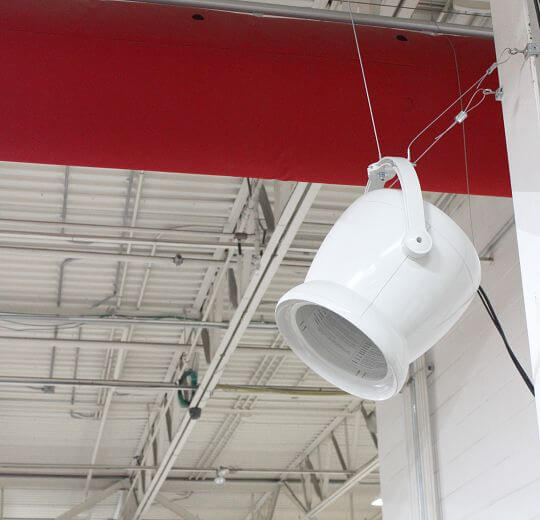
Source: DuctSox Official Website
(https://www.zoofans.com/our-company)
(https://www.zoofans.com/our-company)
Designed by spatial volume, not floor area. Creates a column of air mixing ceiling to floor to inhibit condensation, mold, and rust.
Includes one-touch mounting hardware. Low-cost installation even in warehouses where large HVLS fans won't fit.
| Type | Destratification Fan |
|---|---|
| Size (mm) | 445×391×551 (*3) |
| Coverage | 25 ft (*3) |
| Weight | 20 lb (*3) |
*1 Cool air temperature may vary depending on conditions such as ambient temperature and the surrounding environment. Because it uses water, use caution in areas where moisture is a concern.
*2 Basis and Calculation Method: Calculated based on the maximum airflow (Straight) of “791 CFM” for the “8" (20.3 cm) AXIAL AC PLASTIC MINI-PAK BLOWER (9532-15)” as listed in the catalog.
[Formula] 791 CFM × 0.02832 ≈ 22.4 m³/min (Converted as 1 CFM ≈ 0.02832 m³/min) | Source: Allegro Official Website [PDF] (https://www.allegrosafety.com/wp-content/uploads/2023/01/9532-15-9532-25-9532-15E-9532-25E-AC-Plastic-Blower.pdf)
*3 All specifications are for the H25-EC model.
*2 Basis and Calculation Method: Calculated based on the maximum airflow (Straight) of “791 CFM” for the “8" (20.3 cm) AXIAL AC PLASTIC MINI-PAK BLOWER (9532-15)” as listed in the catalog.
[Formula] 791 CFM × 0.02832 ≈ 22.4 m³/min (Converted as 1 CFM ≈ 0.02832 m³/min) | Source: Allegro Official Website [PDF] (https://www.allegrosafety.com/wp-content/uploads/2023/01/9532-15-9532-25-9532-15E-9532-25E-AC-Plastic-Blower.pdf)
*3 All specifications are for the H25-EC model.