
ProWork Fan Lab » Industrial Heat Stress Prevention: Basics & Countermeasures
Industrial Heat Stress Prevention: Basics & Countermeasures
Index
In factories, warehouses, and large-space facilities, high temperatures can significantly affect employee safety and productivity. Heat stress is a contributing factor in health issues and workplace accidents and is one of the key risks to manage on-site. This article explains the basics of heat stress prevention for industrial sites and outlines location-specific considerations, with a focus on warehouses.
What Is
Heat Stress Prevention?
Heat stress occurs when multiple factors, such as high temperatures and humidity, metabolic heat from physical activity, and clothing, overlap and the body is unable to properly regulate its temperature.
If this condition persists, it can lead to health issues and heat exhaustion and may progress to heat illness, including life-threatening heat stroke in severe cases. To prevent adverse effects, it is important to manage environmental factors such as high temperatures, high humidity, and stagnant air, along with workload and equipment conditions.
Why Heat Stress Prevention Is Important in Industrial
Environments
In recent years, climate change and longer periods of high temperatures have increased the need for measures to address work environments in high heat.
It is a problem not only because it directly strains employees’ health, but also because it can reduce concentration and impair judgment. It can also lead to accidents and inconsistent product quality.
Because it affects productivity and business continuity, it is not just a work environment issue, but an unavoidable business challenge.
Heat Stress Challenges Vary by
Location
The factors that cause heat stress and how it occurs vary depending on the environmental conditions and layout of each use location, including warehouses, factories, outdoor areas, and large-space facilities. Factors influencing heat stress vary from site to site, including work tasks, staffing arrangements, stagnant air, heat from equipment, and climate conditions.
Rather than applying the same measures everywhere, clarify the challenges for each use location and review the appropriate responses.
Examples of Heat Stress Prevention by
Location
Warehouse
In warehouses, high ceilings allow warm air to accumulate near the top, so temperature differences between the upper and lower levels are common. Using airflow and air circulation to even out temperatures is a fundamental part of heat stress prevention for stabilizing on-site conditions.
Factory
In factories, heat generated by machinery and equipment can create localized high-temperature conditions in specific processes. Therefore, ventilation planning and break scheduling tailored to work tasks and staffing layouts are essential.
Outdoor and semi-outdoor
In outdoor and semi-outdoor areas, direct sunlight and natural conditions have a major impact, and temperature swings can quickly change conditions, so shade and temporary airflow measures are needed.
Large space facilities
In large-space facilities, crowding and air conditioning efficiency issues can raise the perceived temperature, so environmental design and operational planning that consider the entire space are needed.
The Role of Industrial Fans in Heat Stress
Prevention
Industrial fans are equipment that improve air circulation through airflow and ventilation, helping prevent heat buildup. By creating airflow, they can lower perceived temperature and promote evaporation of sweat, which enhances the body’s cooling effect from sweating.
However, industrial fans do not directly control temperature or humidity, so they should be used as a supplement alongside air conditioning systems and work practices. They are used as part of heat stress prevention tailored to on-site conditions.
Explore Heat Stress Prevention by
Location
Heat stress prevention approaches vary by use location, so applying the same method across all sites is not appropriate. It is important to start by reviewing the approaches for locations similar to your environment and work activities, such as warehouses, factories, outdoor areas, and large-space facilities.
By starting with the most familiar site conditions, the right direction for your approach becomes clearer.
This article explains heat stress challenges in warehouse environments and how to use industrial fans as part of your prevention approach.
Heat stress prevention works best when you consider approaches that fit on-site environmental conditions. Based on the content of this article, start by reviewing the heat stress prevention approach for warehouse environments, and use it to support future planning and operational reviews.
Three Recommended
Industrial Fan Products Chosen
by Cooling, Exhaust, and Ventilation
Industrial Fan Products Chosen
by Cooling, Exhaust, and Ventilation
Cooling
For Heat Stress Prevention
For Heat Stress Prevention
Gojoh
COOL FAN MIST
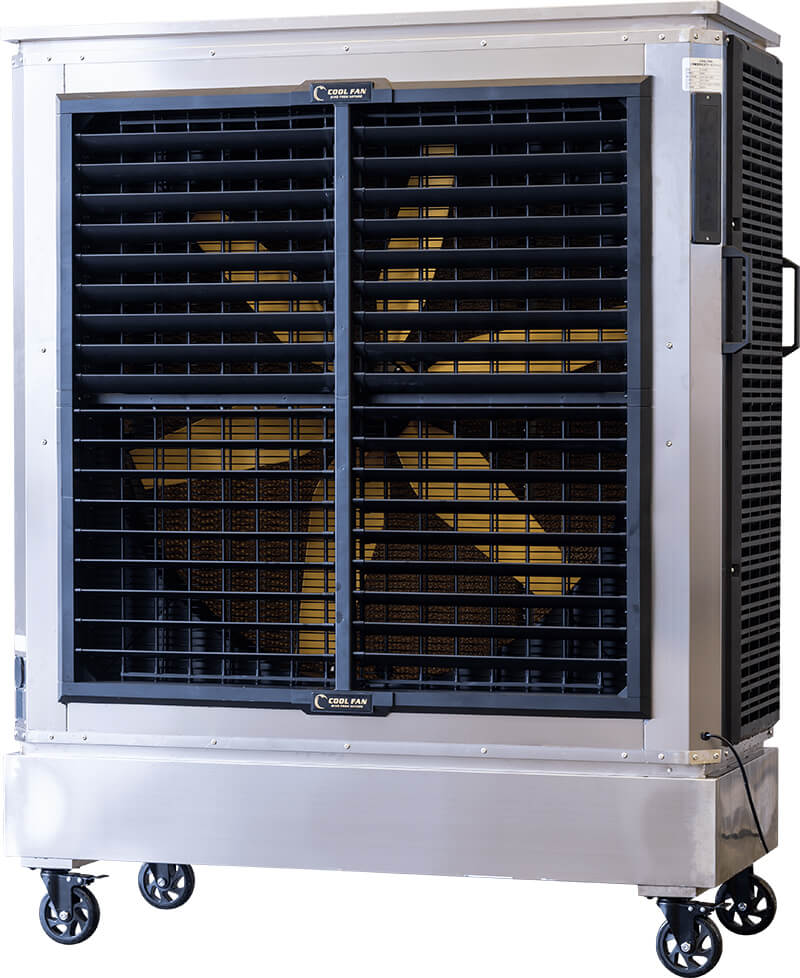
Source: Gojoh Official Website
(https://smile-fans.jp/products/cool-fan-mist/)
(https://smile-fans.jp/products/cool-fan-mist/)
6°C cooler than the surroundings (*1) for 8 hours. Powerful 25m reach + auto-swing to optimize your entire workspace.
Durable, hygienic stainless steel at a portable 210 lbs. Chemical-resistant and built for frequent relocation and long-term use.
| Type | Evaporative cooler |
|---|---|
| Dimensions (in/mm) |
Approx. 59.1" × 25.6" × 70.9" (1500 × 650 × 1800 mm) |
| Coverage Area |
Approx. 2,150–3,230 sq ft |
| Weight | Approx. 210 lb |
Exhaust
For Dust and Smoke Control in Confined Spaces
For Dust and Smoke Control in Confined Spaces
Allegro
8" COM-PAX-IAL Blower
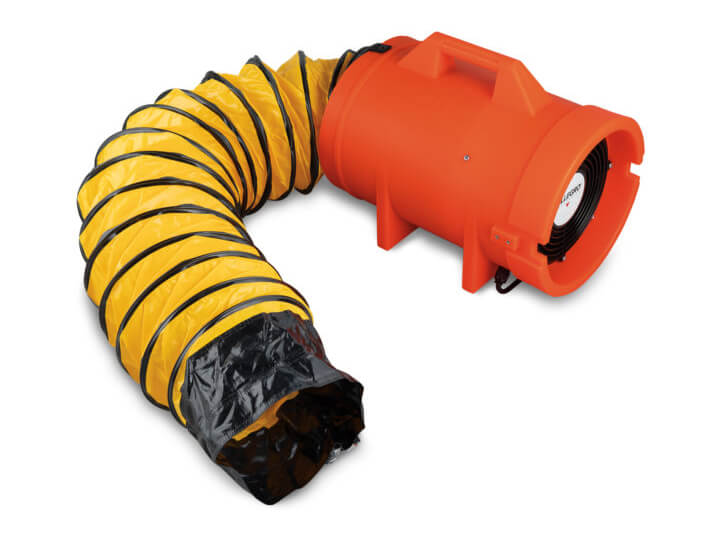
Source: Allegro Official Website
(https://www.allegrosafety.com/product/8-axial-ac-plastic-mini-pak-blower/)
(https://www.allegrosafety.com/product/8-axial-ac-plastic-mini-pak-blower/)
Rapidly exhausts dust/smoke replacing approx. 23.5m³ of air/min (*2). Lightweight polyethylene body is corrosion, UV, and chemical resistant for harsh environments.
Weighs under 19 lbs (lighter than steel) with integrated ducting. Easy to carry and set up, ensuring ventilation protocols are never skipped due to hassle.
| Type | Portable ventilation blower |
|---|---|
| Dimensions (in/mm) |
Approx. 17.5" × 11.3" × 13.5" (445 × 286 × 343 mm) |
| Coverage Area |
N/A |
| Weight | Approx. 19 lb |
Ventilation
For Stagnant Air and Moisture Control
For Stagnant Air and Moisture Control
DuctSox
ZOO FANS H series
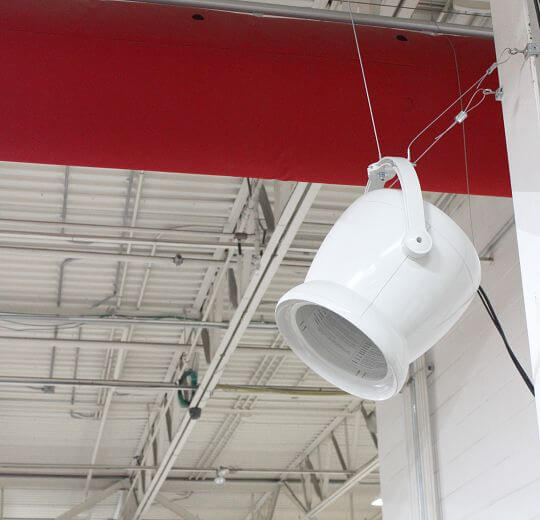
Source: DuctSox Official Website
(https://www.zoofans.com/our-company)
(https://www.zoofans.com/our-company)
Designed by spatial volume, not floor area. Creates a column of air mixing ceiling to floor to inhibit condensation, mold, and rust.
Includes one-touch mounting hardware. Low-cost installation even in warehouses where large HVLS fans won't fit.
| Type | Destratification Fan |
|---|---|
| Size (mm) | 445×391×551 (*3) |
| Coverage | 25 ft (*3) |
| Weight | 20 lb (*3) |
*1 Cool air temperature may vary depending on conditions such as ambient temperature and the surrounding environment. Because it uses water, use caution in areas where moisture is a concern.
*2 Basis and Calculation Method: Calculated based on the maximum airflow (Straight) of “791 CFM” for the “8" (20.3 cm) AXIAL AC PLASTIC MINI-PAK BLOWER (9532-15)” as listed in the catalog.
[Formula] 791 CFM × 0.02832 ≈ 22.4 m³/min (Converted as 1 CFM ≈ 0.02832 m³/min) | Source: Allegro Official Website [PDF] (https://www.allegrosafety.com/wp-content/uploads/2023/01/9532-15-9532-25-9532-15E-9532-25E-AC-Plastic-Blower.pdf)
*3 All specifications are for the H25-EC model.
*2 Basis and Calculation Method: Calculated based on the maximum airflow (Straight) of “791 CFM” for the “8" (20.3 cm) AXIAL AC PLASTIC MINI-PAK BLOWER (9532-15)” as listed in the catalog.
[Formula] 791 CFM × 0.02832 ≈ 22.4 m³/min (Converted as 1 CFM ≈ 0.02832 m³/min) | Source: Allegro Official Website [PDF] (https://www.allegrosafety.com/wp-content/uploads/2023/01/9532-15-9532-25-9532-15E-9532-25E-AC-Plastic-Blower.pdf)
*3 All specifications are for the H25-EC model.