
ProWork Fan Lab » Industrial Fans by Location » The Role of Industrial Fans in Gymnasium Environments
The Role of Industrial Fans in Gymnasium Environments
Index
Gymnasiums combine large enclosed volumes, high ceilings, and heavy use by crowds, which makes air circulation and ventilation hard to manage with the building alone. Beyond summer heat, stale air, humidity, and odor build up during events and daily use.
Industrial fans can circulate air across spaces and, when used as part of a ventilation system, help distribute fresh outdoor air. This article explains the role of fans in gymnasium environments and what to consider when selecting one.
Role of Industrial Fans in Gymnasiums
Industrial fans keep air moving through spaces that have few natural airflow paths, addressing more than temperature alone. Circulating air evens out hot and stagnant pockets, while ventilation brings in fresh air to clear the stale, humid conditions that build up when gymnasiums fill with people.
Controlling airflow also helps manage moisture. Reducing damp, still air lowers the chance of condensation on floors and equipment and helps limit the odor and stuffiness that linger after crowded events, supporting a more comfortable and better-maintained facility.
Environmental Characteristics
and Challenges of Gymnasiums
The tall ceilings built for sports create large upper volumes where warm, humid air rises and accumulates near ceilings, leaving floors and stands separated from the air trapped overhead. With few openings in the walls, cross-ventilation is weak and whole rooms tend to have stagnant air.
Use adds to the load. A facility packed for a game or ceremony generates body heat, moisture, and carbon dioxide faster than the building can clear them, and closed doors during events or winter make it worse. Humidity that has nowhere to go can also damage wooden sports floors and stored equipment over time.
How Industrial Fans
Are Used in Gymnasiums
In main areas, large fans circulate air across the open floor to reduce temperature differences between the ceiling and the court and keep conditions even for players and spectators. This circulation also stops warm, moist air from stagnating high in spaces.
For air quality, fans support ventilation by moving stale air toward openings and helping fresh air reach the center of rooms, which clears odor and lowers humidity after crowded use. During events, portable units add targeted airflow at benches, entrances, and stages where people gather, without needing to treat entire buildings.
Types of Industrial Fans
Suitable for Gymnasiums
For wide-area circulation, HVLS (high-volume, low-speed) ceiling fans suit open floors and high ceilings, moving large volumes of air gently without a strong draft that could affect play. They are effective for mixing trapped upper air with spaces below.
Wall-mounted and portable fans handle more focused needs, directing airflow toward specific zones or assisting ventilation near doors and openings. Where added cooling is needed for events in dry conditions, evaporative fans can lower air temperatures, though their effect depends on the humidity of the gymnasium and works best near entrances rather than over playing surfaces.
Key Points When Selecting
Gymnasium Industrial Fans
Start from the ceiling height and total air volume rather than floor area alone, since these decide whether wide-area circulation, ventilation support, or spot airflow fits the space. Clarify the main goal first, whether that is circulation, ventilation, or moisture control, so the fan type matches actual problems.
Because people use the space directly below, mounting, guarding, and quiet operation are essential, especially for ceremonies and events where noise matters. As long-term equipment, fans should also have a structure that is easy to inspect and clean so performance stays stable across seasons of use.
The right choice depends on the size, structure, and use of each gymnasium. If you are considering industrial fans for locations other than gymnasiums, see below.
Summary of Industrial Fans for Gymnasiums
Moving and Refreshing Air in Large, Enclosed Sports Halls
Industrial fans help gymnasiums circulate trapped air and improve ventilation across a large, sealed volume that the building alone cannot manage. By combining HVLS fans for overall airflow with portable units for events, facilities can control heat, humidity, and stale air while protecting floors and keeping occupants comfortable.
Our media independently researches and introduces recommended industrial fans based on specific needs like cooling, exhaust, and ventilation. Please check our 3 selected products below.
Three Recommended
Industrial Fan Products Chosen
by Cooling, Exhaust, and Ventilation
Industrial Fan Products Chosen
by Cooling, Exhaust, and Ventilation
Cooling
For Heat Stress Prevention
For Heat Stress Prevention
Gojoh
COOL FAN MIST
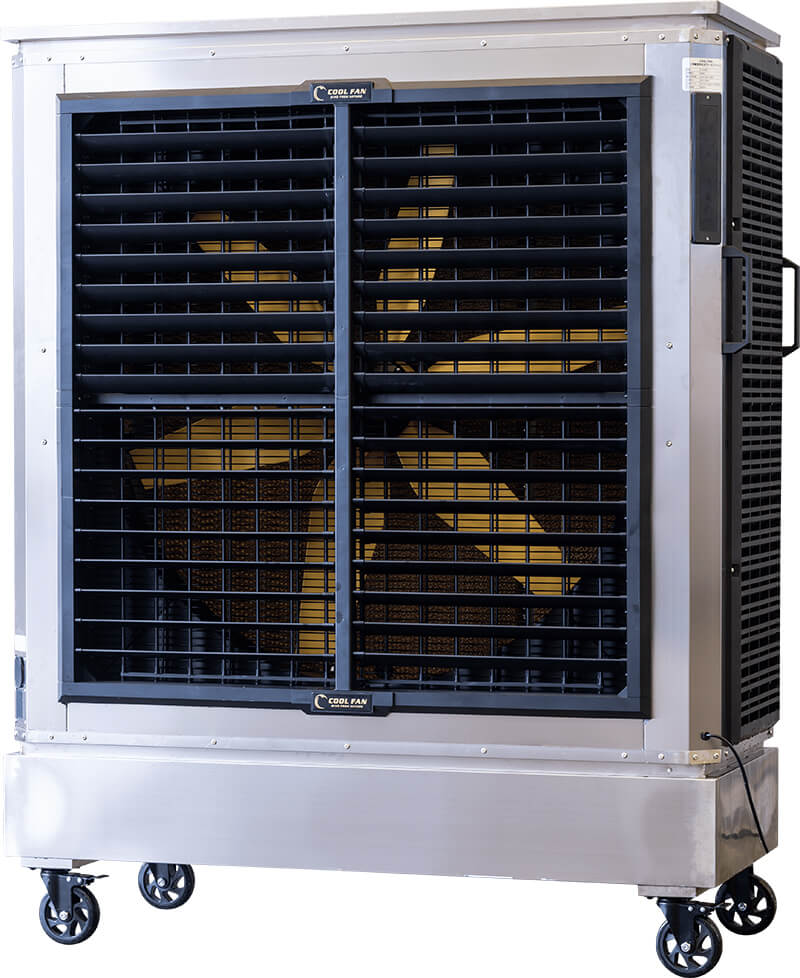
Source: Gojoh Official Website
(https://smile-fans.jp/products/cool-fan-mist/)
(https://smile-fans.jp/products/cool-fan-mist/)
6°C cooler than the surroundings (*1) for 8 hours. Powerful 25m reach + auto-swing to optimize your entire workspace.
Durable, hygienic stainless steel at a portable 210 lbs. Chemical-resistant and built for frequent relocation and long-term use.
| Type | Evaporative cooler |
|---|---|
| Dimensions (in/mm) |
Approx. 59.1" × 25.6" × 70.9" (1500 × 650 × 1800 mm) |
| Coverage Area |
Approx. 2,150–3,230 sq ft |
| Weight | Approx. 210 lb |
Exhaust
For Dust and Smoke Control in Confined Spaces
For Dust and Smoke Control in Confined Spaces
Allegro
8" COM-PAX-IAL Blower
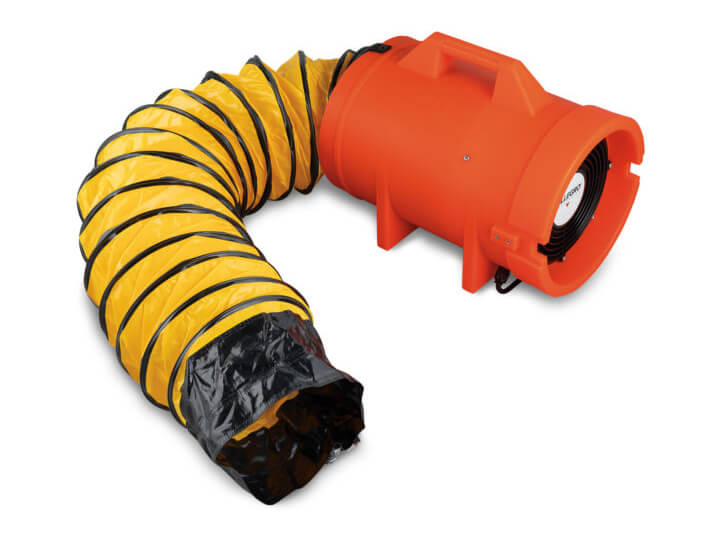
Source: Allegro Official Website
(https://www.allegrosafety.com/product/8-axial-ac-plastic-mini-pak-blower/)
(https://www.allegrosafety.com/product/8-axial-ac-plastic-mini-pak-blower/)
Rapidly exhausts dust/smoke replacing approx. 23.5m³ of air/min (*2). Lightweight polyethylene body is corrosion, UV, and chemical resistant for harsh environments.
Weighs under 19 lbs (lighter than steel) with integrated ducting. Easy to carry and set up, ensuring ventilation protocols are never skipped due to hassle.
| Type | Portable ventilation blower |
|---|---|
| Dimensions (in/mm) |
Approx. 17.5" × 11.3" × 13.5" (445 × 286 × 343 mm) |
| Coverage Area |
N/A |
| Weight | Approx. 19 lb |
Ventilation
For Stagnant Air and Moisture Control
For Stagnant Air and Moisture Control
DuctSox
ZOO FANS H series
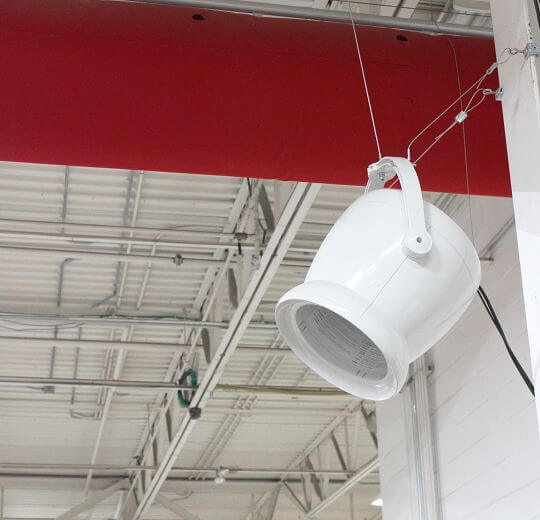
Source: DuctSox Official Website
(https://www.zoofans.com/our-company)
(https://www.zoofans.com/our-company)
Designed by spatial volume, not floor area. Creates a column of air mixing ceiling to floor to inhibit condensation, mold, and rust.
Includes one-touch mounting hardware. Low-cost installation even in warehouses where large HVLS fans won't fit.
| Type | Destratification Fan |
|---|---|
| Size (mm) | 445×391×551 (*3) |
| Coverage | 25 ft (*3) |
| Weight | 20 lb (*3) |
*1 Cool air temperature may vary depending on conditions such as ambient temperature and the surrounding environment. Because it uses water, use caution in areas where moisture is a concern.
*2 Basis and Calculation Method: Calculated based on the maximum airflow (Straight) of “791 CFM” for the “8" (20.3 cm) AXIAL AC PLASTIC MINI-PAK BLOWER (9532-15)” as listed in the catalog.
[Formula] 791 CFM × 0.02832 ≈ 22.4 m³/min (Converted as 1 CFM ≈ 0.02832 m³/min) | Source: Allegro Official Website [PDF] (https://www.allegrosafety.com/wp-content/uploads/2023/01/9532-15-9532-25-9532-15E-9532-25E-AC-Plastic-Blower.pdf)
*3 All specifications are for the H25-EC model.