
ProWork Fan Lab » Industrial Fans Types » How Industrial Water Cooling Fans Provide Localized Cooling
How Industrial Water Cooling Fans Provide Localized Cooling
Index
A water-cooled industrial fan is an industrial fan that uses the evaporative cooling of water to generate cool air and deliver it with strong airflow.
A key feature is that it provides direct cooling to employees in sites where regular fans only circulate hot air or in open areas where air conditioning is difficult to install. This article explains how it works, effective usage scenarios, and key points for installation.
What Is an Industrial Water Cooling Fan?
A water-cooled industrial fan is a product that combines a powerful airflow function with a water-cooling system. Unlike typical industrial fans that only circulate room-temperature air, it can lower the temperature of the air itself before delivering it.
In harsh high-temperature environments where room temperature exceeds body temperature, a standard fan may end up blowing hot air, which limits its cooling effect. However, a water-cooled industrial fan can remove heat from the incoming air and deliver cooler air to employees.
For this reason, it is chosen to support heat stress prevention in areas where air conditioning is ineffective.
How Water Cooling Is Applied
in Industrial Fans
A water-cooled industrial fan uses the principle of evaporative cooling, in which water absorbs heat from the surrounding air as it evaporates. Inside the fan are special cooling pads that are kept saturated with water circulated by a pump. As outside air passes through these wet pads, heat exchange occurs and the air is cooled, then released as cool airflow.
To maintain performance, a water supply is essential. If the tank runs out of water, it becomes just a blower, so maintaining the water supply is a key point in site operation.
Depending on site conditions, operation should be planned around either manual refilling of the tank or automatic water supply using a connected hose.
Typical Applications of
Industrial Water Cooling Fans
It performs especially well in places where overall air conditioning is difficult to implement. Main applications include high-temperature work areas with heat sources, such as casting and welding operations. Even in places where air conditioning is less effective, spot cooling can cool only the employees’ positions precisely.
It is also well suited to semi-outdoor and open spaces such as docks and loading entrances in logistics centers. It can continuously direct cool air toward employees even in open spaces. However, because it relies on evaporative cooling, the effect becomes milder in high-humidity areas where water does not evaporate easily.
Advantages and Considerations of
Industrial Water Cooling Fans
A key advantage is that it can deliver cool air over a wider area than spot air conditioners and more effectively than regular fans. Additionally, because it does not use a compressor, electricity costs can be kept relatively low.
On the other hand, because it uses water, it is important to note that humidity in the area of use will increase.
At sites with precision machinery that is sensitive to moisture or metal products that rust easily, the impact on quality must be considered. It is also important to note that operational tasks such as regular water refilling and tank cleaning for hygiene management will be required.
Key Points When Selecting
an Industrial Water Cooling Fan
To make the right selection, first check the water supply method. If a water supply is available nearby, a direct hose connection is convenient. If not, a manual-fill type with a large-capacity tank is more suitable.
Next, check the ventilation environment. To prevent moisture from building up, it should be used in places with exhaust fans or in environments where windows can be opened.
Finally, maintenance should also be considered. If water is left in the tank, it can cause contamination, so ease of hygiene management is also an important checkpoint for long-term use, including whether the drain outlet is easy to access and whether the tank interior is easy to clean.
Explore Other
Industrial Fan Types
If humidity cannot be tolerated or a wider range of air circulation is needed, considering other cooling methods is recommended. Use industrial fans tailored to the site’s needs, such as large ceiling fans that deliver high airflow or powerful blowers, to improve site comfort.
Summary of Water-Cooled Industrial Fans
Low-Energy Spot Cooling via Evaporative Heat Exchange
Water-cooled industrial fans are a practical solution for lowering air temperature in high-heat areas without the high costs of HVAC. They provide effective relief in open spaces, provided that consistent water supply and proper ventilation are maintained to manage humidity.
Our media independently researches and introduces recommended industrial fans based on specific needs like cooling, exhaust, and ventilation. Please check our 3 selected products below.
Three Recommended
Industrial Fan Products Chosen
by Cooling, Exhaust, and Ventilation
Industrial Fan Products Chosen
by Cooling, Exhaust, and Ventilation
Cooling
For Heat Stress Prevention
For Heat Stress Prevention
Gojoh
COOL FAN MIST
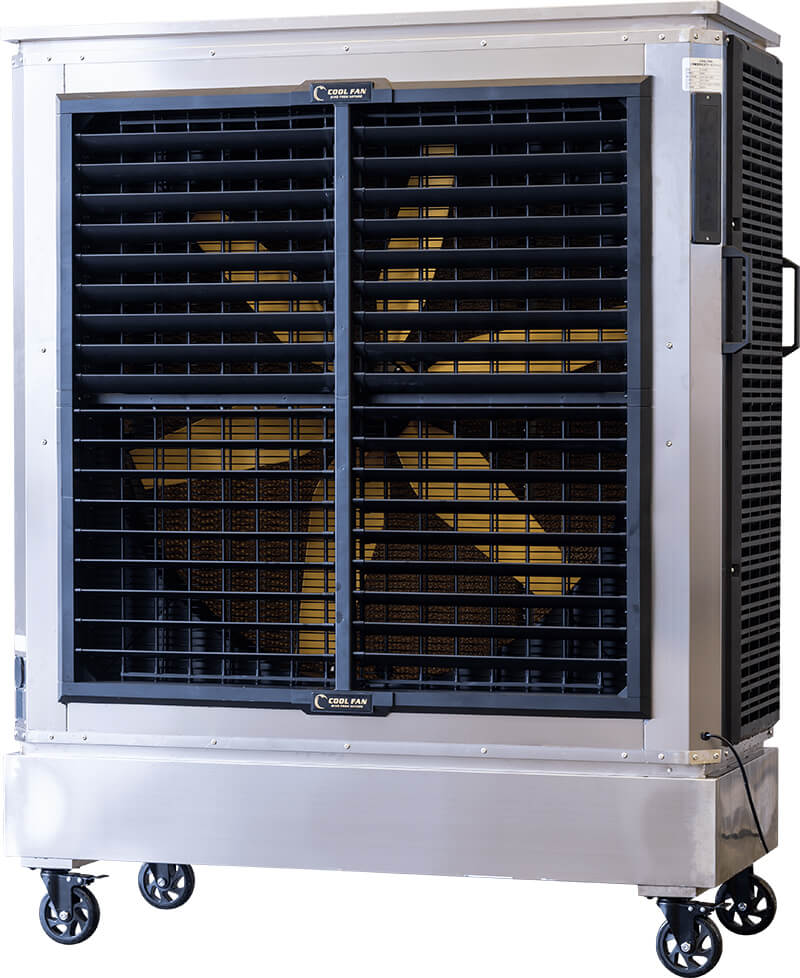
Source: Gojoh Official Website
(https://smile-fans.jp/products/cool-fan-mist/)
(https://smile-fans.jp/products/cool-fan-mist/)
6°C cooler than the surroundings (*1) for 8 hours. Powerful 25m reach + auto-swing to optimize your entire workspace.
Durable, hygienic stainless steel at a portable 210 lbs. Chemical-resistant and built for frequent relocation and long-term use.
| Type | Evaporative cooler |
|---|---|
| Dimensions (in/mm) |
Approx. 59.1" × 25.6" × 70.9" (1500 × 650 × 1800 mm) |
| Coverage Area |
Approx. 2,150–3,230 sq ft |
| Weight | Approx. 210 lb |
Exhaust
For Dust and Smoke Control in Confined Spaces
For Dust and Smoke Control in Confined Spaces
Allegro
8" COM-PAX-IAL Blower
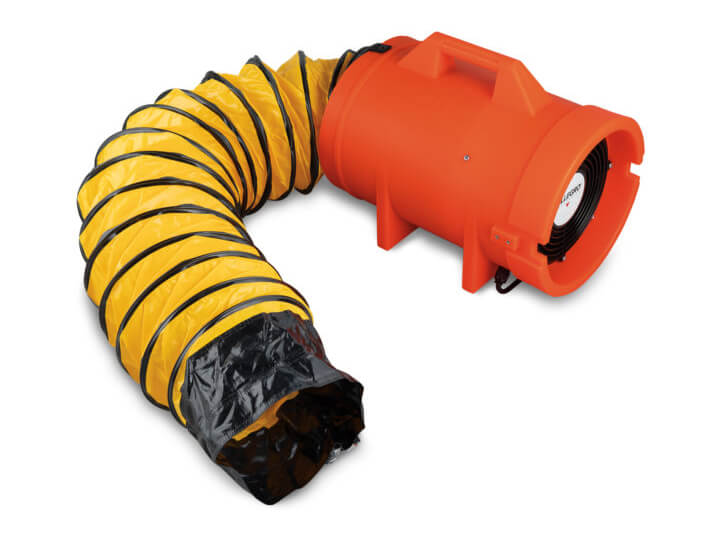
Source: Allegro Official Website
(https://www.allegrosafety.com/product/8-axial-ac-plastic-mini-pak-blower/)
(https://www.allegrosafety.com/product/8-axial-ac-plastic-mini-pak-blower/)
Rapidly exhausts dust/smoke replacing approx. 23.5m³ of air/min (*2). Lightweight polyethylene body is corrosion, UV, and chemical resistant for harsh environments.
Weighs under 19 lbs (lighter than steel) with integrated ducting. Easy to carry and set up, ensuring ventilation protocols are never skipped due to hassle.
| Type | Portable ventilation blower |
|---|---|
| Dimensions (in/mm) |
Approx. 17.5" × 11.3" × 13.5" (445 × 286 × 343 mm) |
| Coverage Area |
N/A |
| Weight | Approx. 19 lb |
Ventilation
For Stagnant Air and Moisture Control
For Stagnant Air and Moisture Control
DuctSox
ZOO FANS H series
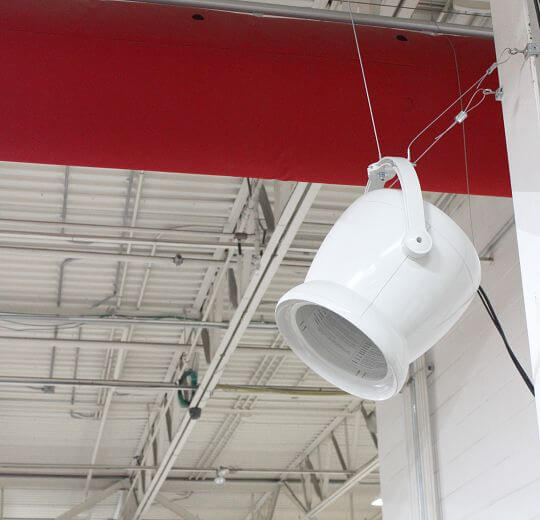
Source: DuctSox Official Website
(https://www.zoofans.com/our-company)
(https://www.zoofans.com/our-company)
Designed by spatial volume, not floor area. Creates a column of air mixing ceiling to floor to inhibit condensation, mold, and rust.
Includes one-touch mounting hardware. Low-cost installation even in warehouses where large HVLS fans won't fit.
| Type | Destratification Fan |
|---|---|
| Size (mm) | 445×391×551 (*3) |
| Coverage | 25 ft (*3) |
| Weight | 20 lb (*3) |
*1 Cool air temperature may vary depending on conditions such as ambient temperature and the surrounding environment. Because it uses water, use caution in areas where moisture is a concern.
*2 Basis and Calculation Method: Calculated based on the maximum airflow (Straight) of “791 CFM” for the “8" (20.3 cm) AXIAL AC PLASTIC MINI-PAK BLOWER (9532-15)” as listed in the catalog.
[Formula] 791 CFM × 0.02832 ≈ 22.4 m³/min (Converted as 1 CFM ≈ 0.02832 m³/min) | Source: Allegro Official Website [PDF] (https://www.allegrosafety.com/wp-content/uploads/2023/01/9532-15-9532-25-9532-15E-9532-25E-AC-Plastic-Blower.pdf)
*3 All specifications are for the H25-EC model.
*2 Basis and Calculation Method: Calculated based on the maximum airflow (Straight) of “791 CFM” for the “8" (20.3 cm) AXIAL AC PLASTIC MINI-PAK BLOWER (9532-15)” as listed in the catalog.
[Formula] 791 CFM × 0.02832 ≈ 22.4 m³/min (Converted as 1 CFM ≈ 0.02832 m³/min) | Source: Allegro Official Website [PDF] (https://www.allegrosafety.com/wp-content/uploads/2023/01/9532-15-9532-25-9532-15E-9532-25E-AC-Plastic-Blower.pdf)
*3 All specifications are for the H25-EC model.