
How Portable Industrial Fans Provide Localized Cooling
Index
Portable industrial fans are airflow equipment that can be installed without construction work to address localized heat and stagnant air that fixed equipment may struggle to handle.
This article explains the site conditions where portable fans are effective and how to use them appropriately alongside fixed equipment. You can use this as a reference for improving site conditions and when considering equipment installation.
What Is a Portable Industrial Fan?
These are industrial blowers equipped with casters and handles, allowing employees to move and set them up easily. They can be brought to where they are needed and used there without the need for construction or a fixed layout, which is a key feature.
When the goal is to cover entire factories or warehouses, airflow equipment using ducts or large ceiling-mounted fans may be selected, but this can create construction or layout constraints. In contrast, portable fans can be moved as needed and are intended to address localized heat and stagnant air that fixed equipment cannot fully manage.
How Portable Industrial Fans
Are Used
The goal is to reduce localized heat and stagnant air through targeted airflow. By concentrating airflow around process areas where employees remain for long periods or near machines that generate high heat, it helps reduce felt temperature and stabilize the work environment.
They are also useful in situations involving non-routine tasks, such as equipment maintenance or line modifications. In temporary environments where fixed ventilation is less effective, they can supplement airflow and ventilation for the required period, allowing for smooth adaptation to changes in work requirements. This ease of use is highly valued.
Typical Applications of
Portable Industrial Fans
Within factories, they are used in areas where heat tends to concentrate around specific processes such as casting, welding, and heating. They are typically installed next to or behind machines so that airflow can be directed toward heat sources based on where employees are positioned.
In warehouses, they are often installed in areas where picking operations take place or around loading docks where trucks come and go. They are positioned to avoid foot traffic and placed where airflow can reach the work area. In spaces under eaves or in semi-outdoor work areas, they may also be used to draw in outside air, and their use varies depending on the purpose.
Advantages and Limitations of
Portable Industrial Fans
A key advantage is the ability to use it flexibly in response to changes in site conditions. At sites where work positions are not fixed or workloads vary depending on the process or time of year, it can be moved and used where needed. Not requiring installation work is also an advantage during implementation.
On the other hand, there are limits to the airflow range and output. It is not suitable for ventilating entire large spaces or managing the overall thermal environment.
When addressing localized imbalances or stagnant air within an existing environment, it is important to determine whether a portable fan is appropriate based on operating conditions such as whether work positions are fixed and how long it will be used.
Key Points When Selecting
a Portable Industrial Fan
When considering a portable fan, first clarify the intended airflow target. This is because the required performance and size will differ depending on whether the goal is to improve the work environment for employees, address heat around machinery, or create airflow.
It is also essential to confirm installation and operating conditions. In addition to site conditions such as power supply location and aisle width, ease of handling the unit and safety considerations based on how often it will be moved are essential for operation. It is important to judge not only by the performance listed in the catalog, but also by whether it can be handled without issues in actual use scenarios.
Explore Other
Industrial Fan Types
Portable industrial fans cannot solve all air conditioning issues in factories and warehouses. Depending on the installation environment and the desired coverage area, large wall-mounted or ceiling-mounted fans may also be more suitable. Based on the overall site conditions, it is important to consider fan types that match the purpose.
Summary of Portable Industrial Fans
Flexible Airflow Solutions for Targeted Heat Relief
Portable industrial fans offer a practical, no-construction solution to address localized heat and stagnant air. They are highly effective for dynamic environments, allowing facilities to adapt quickly to layout changes and provide relief exactly where employees need it most.
Our media independently researches and introduces recommended industrial fans based on specific needs like cooling, exhaust, and ventilation. Please check our 3 selected products below.
Three Recommended
Industrial Fan Products Chosen
by Cooling, Exhaust, and Ventilation
Industrial Fan Products Chosen
by Cooling, Exhaust, and Ventilation
Cooling
For Heat Stress Prevention
For Heat Stress Prevention
Gojoh
COOL FAN MIST
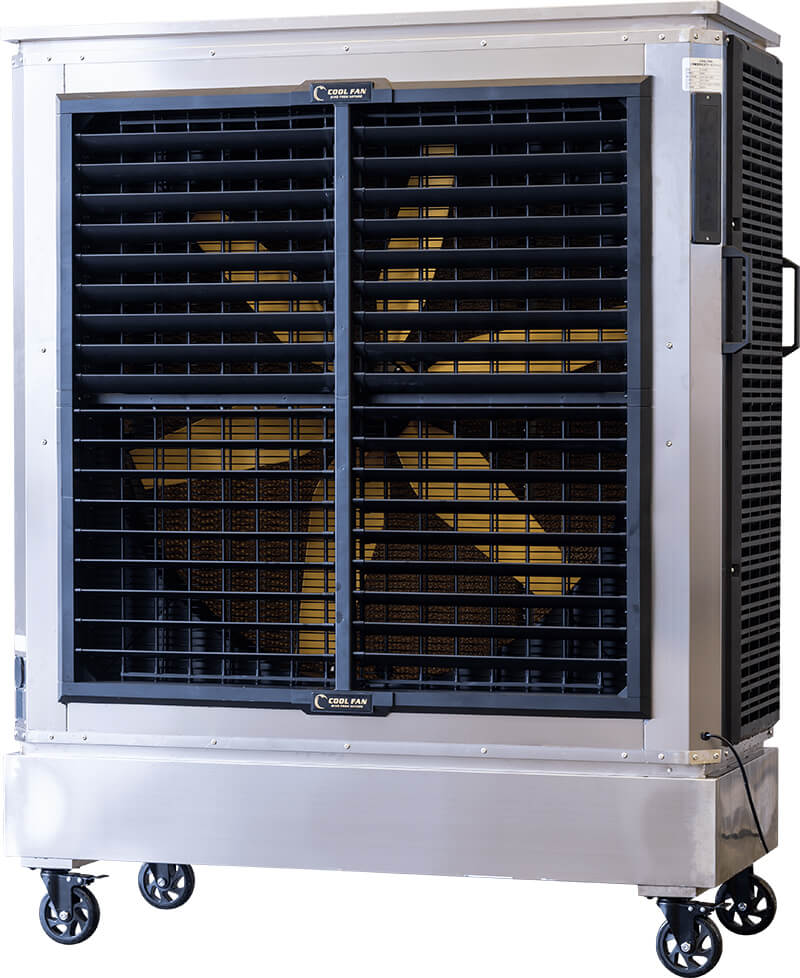
Source: Gojoh Official Website
(https://smile-fans.jp/products/cool-fan-mist/)
(https://smile-fans.jp/products/cool-fan-mist/)
6°C cooler than the surroundings (*1) for 8 hours. Powerful 25m reach + auto-swing to optimize your entire workspace.
Durable, hygienic stainless steel at a portable 210 lbs. Chemical-resistant and built for frequent relocation and long-term use.
| Type | Evaporative cooler |
|---|---|
| Dimensions (in/mm) |
Approx. 59.1" × 25.6" × 70.9" (1500 × 650 × 1800 mm) |
| Coverage Area |
Approx. 2,150–3,230 sq ft |
| Weight | Approx. 210 lb |
Exhaust
For Dust and Smoke Control in Confined Spaces
For Dust and Smoke Control in Confined Spaces
Allegro
8" COM-PAX-IAL Blower
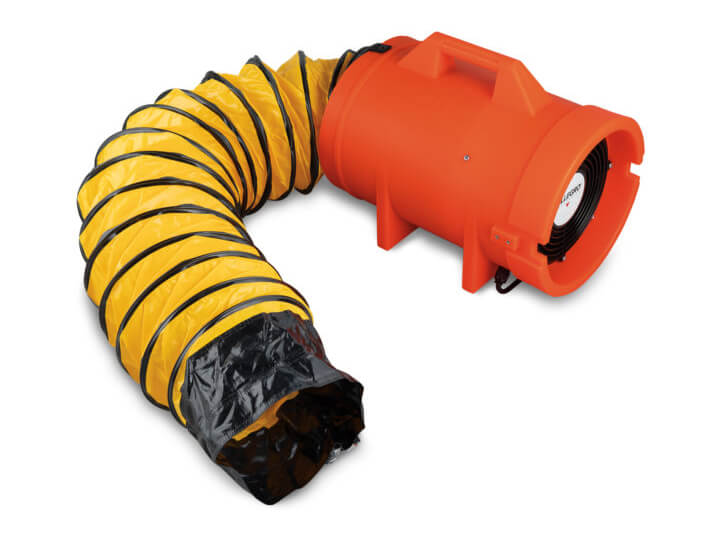
Source: Allegro Official Website
(https://www.allegrosafety.com/product/8-axial-ac-plastic-mini-pak-blower/)
(https://www.allegrosafety.com/product/8-axial-ac-plastic-mini-pak-blower/)
Rapidly exhausts dust/smoke replacing approx. 23.5m³ of air/min (*2). Lightweight polyethylene body is corrosion, UV, and chemical resistant for harsh environments.
Weighs under 19 lbs (lighter than steel) with integrated ducting. Easy to carry and set up, ensuring ventilation protocols are never skipped due to hassle.
| Type | Portable ventilation blower |
|---|---|
| Dimensions (in/mm) |
Approx. 17.5" × 11.3" × 13.5" (445 × 286 × 343 mm) |
| Coverage Area |
N/A |
| Weight | Approx. 19 lb |
Ventilation
For Stagnant Air and Moisture Control
For Stagnant Air and Moisture Control
DuctSox
ZOO FANS H series
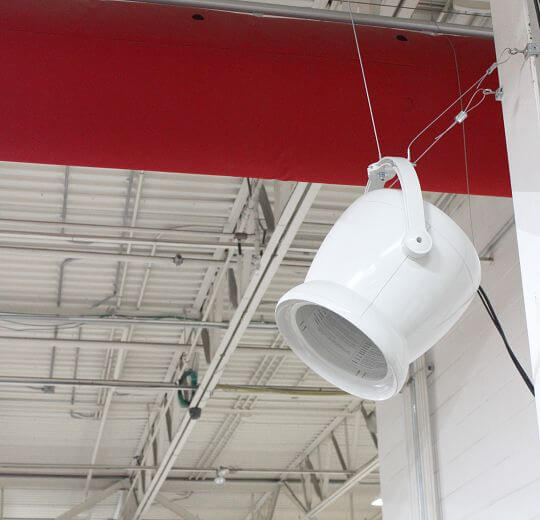
Source: DuctSox Official Website
(https://www.zoofans.com/our-company)
(https://www.zoofans.com/our-company)
Designed by spatial volume, not floor area. Creates a column of air mixing ceiling to floor to inhibit condensation, mold, and rust.
Includes one-touch mounting hardware. Low-cost installation even in warehouses where large HVLS fans won't fit.
| Type | Destratification Fan |
|---|---|
| Size (mm) | 445×391×551 (*3) |
| Coverage | 25 ft (*3) |
| Weight | 20 lb (*3) |
*1 Cool air temperature may vary depending on conditions such as ambient temperature and the surrounding environment. Because it uses water, use caution in areas where moisture is a concern.
*2 Basis and Calculation Method: Calculated based on the maximum airflow (Straight) of “791 CFM” for the “8" (20.3 cm) AXIAL AC PLASTIC MINI-PAK BLOWER (9532-15)” as listed in the catalog.
[Formula] 791 CFM × 0.02832 ≈ 22.4 m³/min (Converted as 1 CFM ≈ 0.02832 m³/min) | Source: Allegro Official Website [PDF] (https://www.allegrosafety.com/wp-content/uploads/2023/01/9532-15-9532-25-9532-15E-9532-25E-AC-Plastic-Blower.pdf)
*3 All specifications are for the H25-EC model.
*2 Basis and Calculation Method: Calculated based on the maximum airflow (Straight) of “791 CFM” for the “8" (20.3 cm) AXIAL AC PLASTIC MINI-PAK BLOWER (9532-15)” as listed in the catalog.
[Formula] 791 CFM × 0.02832 ≈ 22.4 m³/min (Converted as 1 CFM ≈ 0.02832 m³/min) | Source: Allegro Official Website [PDF] (https://www.allegrosafety.com/wp-content/uploads/2023/01/9532-15-9532-25-9532-15E-9532-25E-AC-Plastic-Blower.pdf)
*3 All specifications are for the H25-EC model.