
ProWork Fan Lab » Industrial Heat Stress Prevention: Basics & Countermeasures » Outdoor Heat Stress Prevention Using Cooling Fans
Outdoor Heat Stress Prevention Using Cooling Fans
Index
Outdoor worksites and events have no walls to contain cooled air and may have limited shade provided from direct sunlight, so heat builds up fast and puts workers and crowds at risk. With air conditioning out of the question, portable cooling that can be aimed where people are becomes the practical answer. This article explains outdoor heat stress challenges and how cooling fans are used to address them.
Why Heat Stress Is a Problem Outdoors
Heat Stress Risks at Outdoor Worksites
Direct sunlight and heat radiating off pavement, equipment, and metal surfaces push the perceived temperature well above the shade reading, especially during physical work. Without breaks from the heat, workers face rising risks of heat exhaustion and heat stroke, and fatigue leads to slower work and more mistakes as the day goes on.
Key Challenges of Outdoor
Heat Stress Prevention
No Enclosure to Hold Cooled Air
Open-air sites have nothing to contain airflow or cooling, so any relief disperses quickly into the surrounding air. Cooling has to be directed straight at the people who need it rather than spread across a whole area, which changes how equipment should be positioned.
Direct Sun and Radiant Heat
Sunlit surfaces keep radiating heat even when the air itself is moving, so airflow alone does not always bring the perceived temperature down enough. In these conditions, adding evaporative cooling to the airflow makes a clearer difference than moving hot air on its own.
No Fixed Power or Water, and Temporary Setups
Outdoor sites rarely have convenient power outlets or water lines, and layouts change day to day. Equipment needs to be portable, quick to set up, and easy to reposition so cooling can follow the work instead of staying fixed in one spot.
Role of Fans in Outdoor
Heat Stress Prevention
How Cooling Fans
Help Reduce Heat Stress Outdoors
Cooling fans lower the temperature workers feel by moving air across skin, and evaporative models add real cooling by spraying a fine mist that absorbs heat as it evaporates. Aimed at a work area or a rest point, they create cooler pockets where people spend the most time, helping people to recover between bursts of exertion.
Where to Position Fans Outdoors
Placement decides how much of the airflow actually reaches people, since open air scatters it fast. Directing fans at fixed work stations, staging areas, and shaded rest points, and setting them upwind so the breeze carries toward workers, keeps the cooling effect where it counts.
Types of Fans Used for Outdoor
Heat Stress Prevention
Evaporative Cooling (Misting) Fans
These fans spray water as a fine mist and cool the air through evaporation, delivering cooled air rather than a warm breeze. They are most effective in dry conditions and work well outdoors where the mist can evaporate before settling, making them a common choice for construction sites and open work areas in hot, low-humidity regions.
Portable High-Velocity Fans
High-velocity fans push strong, focused streams of air over a longer distances, which suits spot cooling at individual work stations. With no water involved, they avoid wet surfaces and are simple to move around a changing site, though they lower perceived temperature through airflow rather than cooling the air itself.
Large Misting Fans for Event Areas
For outdoor events, tents, and spectator areas, larger evaporative units cover a wide area for crowds gathered in one place. They install without permanent construction, making them a practical temporary measure for venues where people stay in the same spots for hours.
Points to Consider When Selecting an
Outdoor Heat Stress Cooling Fan
Weather Resistance and Durability
Outdoor use exposes equipment to UV, dust, and moisture, so a corrosion- and weather-resistant build matters for reliable operation across a season. Check that the materials and rating suit continuous outdoor use rather than occasional indoor duty.
Power and Water Supply
Confirm how the fans will be powered and, for evaporative models, how water will be supplied. A tank-based unit that runs on standard power avoids the need for a fixed water line and plumbing work, which suits sites without infrastructure.
Humidity and Wind Conditions
Evaporative cooling weakens as humidity rises, and strong wind scatters both mist and airflow before they reach workers. Match the fan type to the site's typical humidity and wind, and favor focused airflow where evaporative cooling would be less reliable.
Summary: Choosing the Right Fans
for Outdoor Heat Stress Prevention
Outdoor sites lose cooling to open air and radiant heat, so the goal is to deliver relief straight to where people work and rest. Cooling fans, and evaporative models in dry conditions, create cooler pockets without permanent installation. Choose based on the site's humidity, wind, and available power and water so the cooling holds up through the day.
Summary: Heat Stress Prevention Outdoors
Bringing Cooling to Sites With No Walls and No Shade
Outdoor worksites and events cannot rely on air conditioning, leaving workers exposed to direct sun and radiant heat. Portable cooling fans, especially evaporative models in dry climates, deliver targeted relief exactly where people gather and help protect against heat-related illness through the hottest hours.
Our media independently researches and introduces recommended industrial fans based on specific needs like cooling, exhaust, and ventilation. Please check our 3 selected products below.
Three Recommended
Industrial Fan Products Chosen
by Cooling, Exhaust, and Ventilation
Industrial Fan Products Chosen
by Cooling, Exhaust, and Ventilation
Cooling
For Heat Stress Prevention
For Heat Stress Prevention
Gojoh
COOL FAN MIST
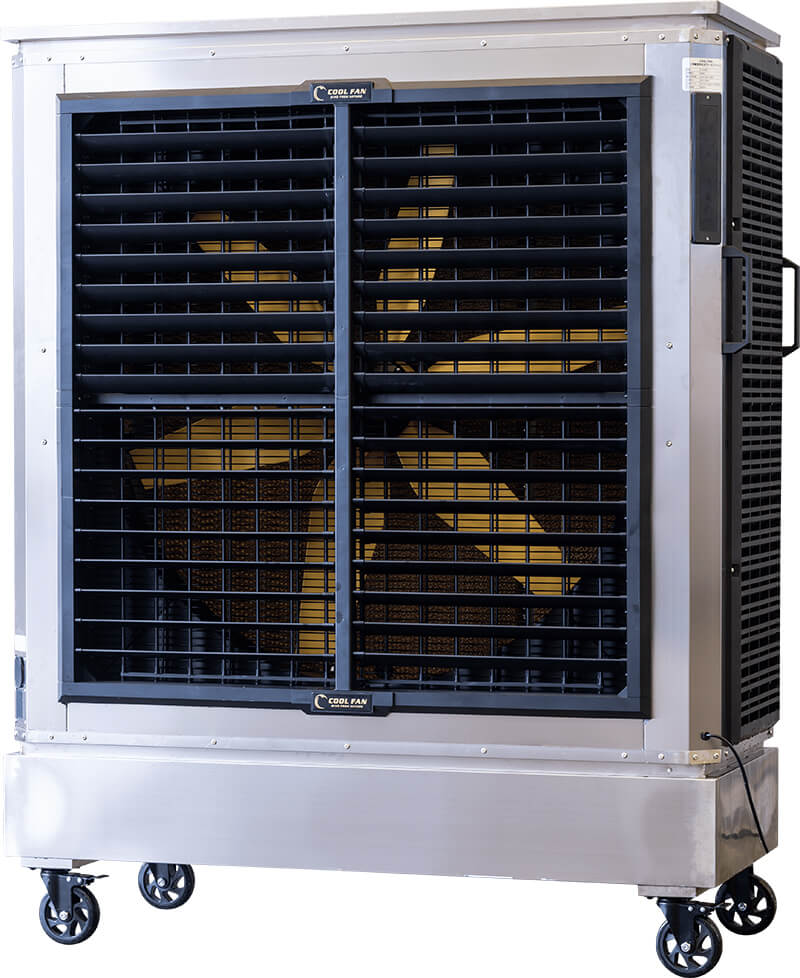
Source: Gojoh Official Website
(https://smile-fans.jp/products/cool-fan-mist/)
(https://smile-fans.jp/products/cool-fan-mist/)
6°C cooler than the surroundings (*1) for 8 hours. Powerful 25m reach + auto-swing to optimize your entire workspace.
Durable, hygienic stainless steel at a portable 210 lbs. Chemical-resistant and built for frequent relocation and long-term use.
| Type | Evaporative cooler |
|---|---|
| Dimensions (in/mm) |
Approx. 59.1" × 25.6" × 70.9" (1500 × 650 × 1800 mm) |
| Coverage Area |
Approx. 2,150–3,230 sq ft |
| Weight | Approx. 210 lb |
Exhaust
For Dust and Smoke Control in Confined Spaces
For Dust and Smoke Control in Confined Spaces
Allegro
8" COM-PAX-IAL Blower
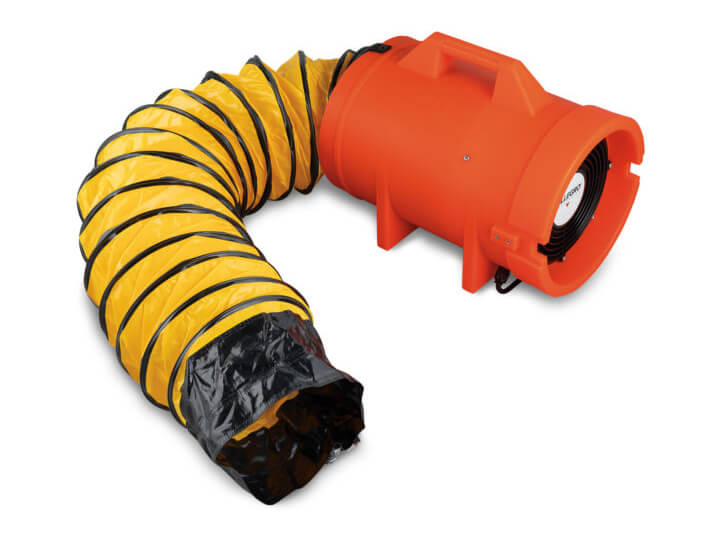
Source: Allegro Official Website
(https://www.allegrosafety.com/product/8-axial-ac-plastic-mini-pak-blower/)
(https://www.allegrosafety.com/product/8-axial-ac-plastic-mini-pak-blower/)
Rapidly exhausts dust/smoke replacing approx. 23.5m³ of air/min (*2). Lightweight polyethylene body is corrosion, UV, and chemical resistant for harsh environments.
Weighs under 19 lbs (lighter than steel) with integrated ducting. Easy to carry and set up, ensuring ventilation protocols are never skipped due to hassle.
| Type | Portable ventilation blower |
|---|---|
| Dimensions (in/mm) |
Approx. 17.5" × 11.3" × 13.5" (445 × 286 × 343 mm) |
| Coverage Area |
N/A |
| Weight | Approx. 19 lb |
Ventilation
For Stagnant Air and Moisture Control
For Stagnant Air and Moisture Control
DuctSox
ZOO FANS H series
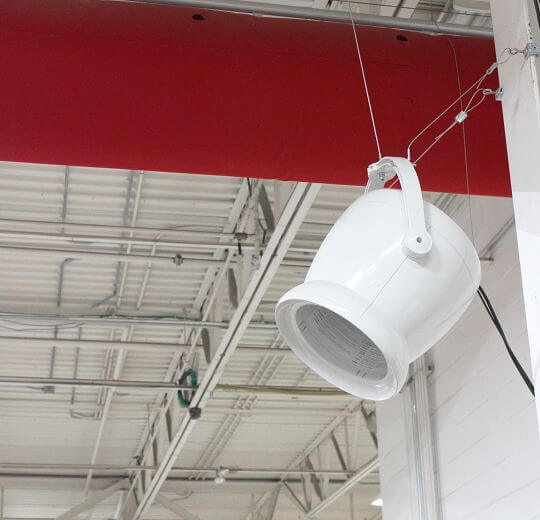
Source: DuctSox Official Website
(https://www.zoofans.com/our-company)
(https://www.zoofans.com/our-company)
Designed by spatial volume, not floor area. Creates a column of air mixing ceiling to floor to inhibit condensation, mold, and rust.
Includes one-touch mounting hardware. Low-cost installation even in warehouses where large HVLS fans won't fit.
| Type | Destratification Fan |
|---|---|
| Size (mm) | 445×391×551 (*3) |
| Coverage | 25 ft (*3) |
| Weight | 20 lb (*3) |
*1 Cool air temperature may vary depending on conditions such as ambient temperature and the surrounding environment. Because it uses water, use caution in areas where moisture is a concern.
*2 Basis and Calculation Method: Calculated based on the maximum airflow (Straight) of “791 CFM” for the “8" (20.3 cm) AXIAL AC PLASTIC MINI-PAK BLOWER (9532-15)” as listed in the catalog.
[Formula] 791 CFM × 0.02832 ≈ 22.4 m³/min (Converted as 1 CFM ≈ 0.02832 m³/min) | Source: Allegro Official Website [PDF] (https://www.allegrosafety.com/wp-content/uploads/2023/01/9532-15-9532-25-9532-15E-9532-25E-AC-Plastic-Blower.pdf)
*3 All specifications are for the H25-EC model.