
ProWork Fan Lab » Industrial Heat Stress Prevention: Basics & Countermeasures » Heat Stress Prevention in Factories Using Industrial Fans
Heat Stress Prevention in Factories Using Industrial Fans
Index
Factory floors heat up not only from summer weather but also from machinery, motors, and radiant heat sources running throughout the day. Air conditioning alone often struggles to reach work areas in large, high-ceiling spaces, so site-specific measures are needed. This article explains the heat stress challenges specific to factories and how industrial fans are used to address them.
Why Heat Stress Is a Problem in Factories
Heat Stress Risks in Factory Environments
Machinery, furnaces, and welding processes add heat to the air on top of high summer temperatures, pushing work areas to temperatures that outdoor weather data alone does not capture. Workers near these heat sources are exposed to both high air temperatures and radiant heat, which raises the risk of heat-related illness even when the overall building feels manageable.
Heat stress reduces concentration and slows judgment before workers notice it themselves. On a production line, this causes up as more errors, slower output, and a higher risk of accidents around moving equipment and forklifts.
Key Challenges of Heat Stress
Prevention
in Factories
Heat from Machinery
and Radiant Sources
Equipment such as furnaces, ovens, molding machines, and motors keep releasing heat while productions are running, creating localized hot zones that do not cool down on their own. Because the heat comes from inside the building rather than only from outside, lowering the air conditioning setting has little effect on the areas that need it most.
High Ceilings
and Temperature Stratification
Warm air rises and collects near the ceiling in tall factory buildings, while while work zones at floor level stay hot and stagnant. This stratification traps heat in the upper space, and natural ventilation alone rarely moves enough air to break it up.
Limited Effectiveness
of Air Conditioning Alone
Cool air struggles to reach open production areas and dissipates before it settles where workers stand. Large machinery also block airflow paths, leaving dead zones that stay hot no matter how low the thermostat is set. Cooling the entire volume of a large factory to fix a few hot spots drives up energy costs without solving the underlying problem.
Role of Fans in Factory
Heat Stress Prevention
How Industrial Fans
Help Reduce Heat Stress
Industrial fans move large volumes of air to break up the hot layer near ceilings and keep air circulating through work zones. Moving air over skin lowers the temperatures workers actually feel, even when the measured air temperature stays the same. Directing airflow at specific lines or stations also clears the stagnant pockets that form around machinery.
Fans vs. Air Conditioning
in Factory Environments
Air conditioning lowers air temperature but loses efficiency in open, high-ceiling spaces, while fans improve comfort by moving air where workers need it and may use less energy than cooling entire spaces with air conditioning. Used together, fans carry conditioned air into work zones and reduce the load on air conditioning systems, making the two more effective in combination than either one alone.
Types of Fans Used for Factory
Heat Stress Prevention
Evaporative Cooling (Misting) Fans
These fans lower air temperature by using the latent heat of water evaporation, so they deliver cooled air rather than moving air alone. They work best in dry regions and near open production areas where the mist can evaporate cleanly, and because they need no ductwork or refrigerant, they suit sites where full air conditioning is impractical. Cooling performance depends on humidity, so operating environments should be confirmed before installation.
Spot and Portable
High-Pressure Fans
High-pressure airflow reaches farther and pushes into the dead zones between densely packed machines that fixed equipment cannot cover. Portable units can be repositioned as production layouts change, making them a practical way to cool a specific line or workstation where peak heat is the priority.
HVLS Fans
HVLS (high-volume, low-speed) ceiling fans move a large volume of air across a wide area at low rotational speeds. They are suited to high-ceiling factories where spot cooling cannot keep up, mixing the warm air trapped near the ceilings with the work zone below to even out temperature across the whole spaces.
Points to Consider When Selecting a
Factory Heat Stress Prevention Fans
Heat Sources
and Work Area Conditions
Start by identifying where the heat comes from and who is exposed to it. A line running beside a furnace needs targeted spot cooling, while a large assembly floor with even heat buildup calls for wide-area circulation. Matching the fan type to the specific hot zone matters more than raw airflow figures.
Humidity and Ventilation Conditions
Evaporative cooling loses effect as humidity rises, and moving very hot air in poorly ventilated spaces can spread heat rather than relieve it. Check the site's humidity level and existing ventilation first, since these determine whether cooled airflow, plain circulation, or added exhaust is the right approach.
Safety, Layout, and Maintenance
Fans must not obstruct forklift routes, walkways, or the operation of nearby machinery, so placement should be planned around daily workflow. For equipment meant to operate throughout summer, a structure that is easy to inspect and clean keeps cooling performance stable and reduces downtime over the long term.
Summary: Choosing the Right Fan
for Factory Heat Stress Prevention
Factory heat comes from machinery and radiant sources as well as the weather, so it concentrates in specific zones that whole-building air conditioning cannot cool efficiently. Industrial fans address this by breaking up trapped heat and delivering airflow where workers actually stand. The right choice depends on where the heat builds up, the site's humidity, and the daily workflow, so match the fan type to your specific conditions.
Summary: Heat Stress Prevention for Factories
Cooling the Hot Zones Air Conditioning Cannot Reach
Factories build up heat around machinery and near the ceiling, where standard air conditioning falls short. Industrial fans deliver airflow directly to work zones and, used alongside air conditioning, help protect worker safety and keep production stable through peak summer temperatures.
Our media independently researches and introduces recommended industrial fans based on specific needs like cooling, exhaust, and ventilation. Please check our 3 selected products below.
Three Recommended
Industrial Fan Products Chosen
by Cooling, Exhaust, and Ventilation
Industrial Fan Products Chosen
by Cooling, Exhaust, and Ventilation
Cooling
For Heat Stress Prevention
For Heat Stress Prevention
Gojoh
COOL FAN MIST
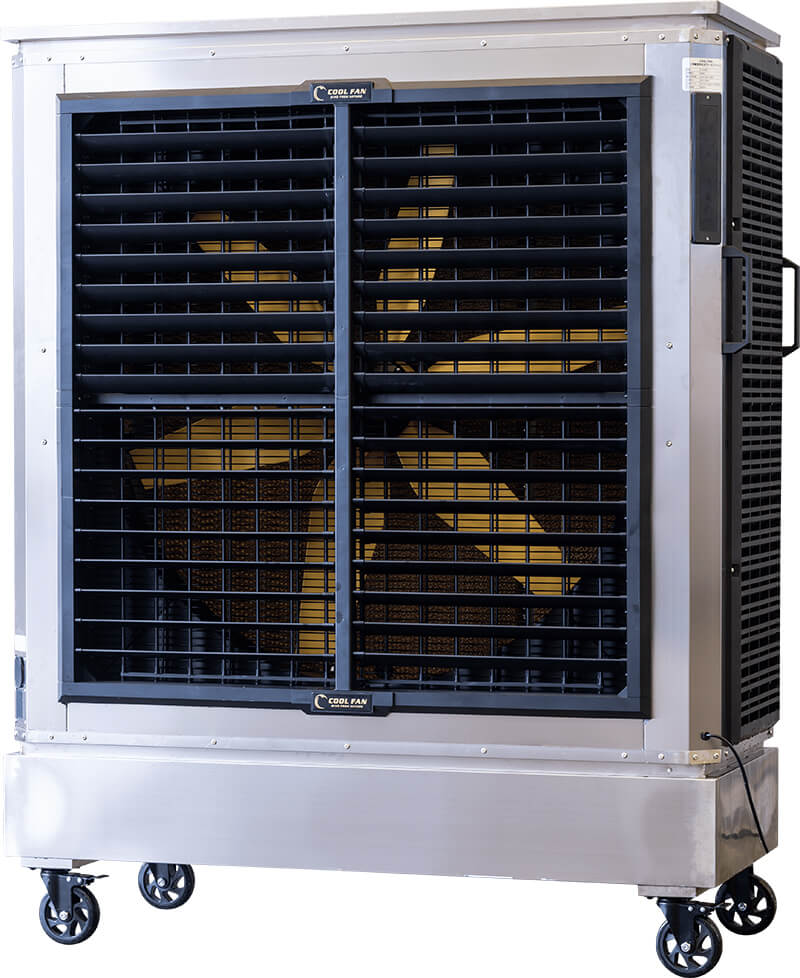
Source: Gojoh Official Website
(https://smile-fans.jp/products/cool-fan-mist/)
(https://smile-fans.jp/products/cool-fan-mist/)
6°C cooler than the surroundings (*1) for 8 hours. Powerful 25m reach + auto-swing to optimize your entire workspace.
Durable, hygienic stainless steel at a portable 210 lbs. Chemical-resistant and built for frequent relocation and long-term use.
| Type | Evaporative cooler |
|---|---|
| Dimensions (in/mm) |
Approx. 59.1" × 25.6" × 70.9" (1500 × 650 × 1800 mm) |
| Coverage Area |
Approx. 2,150–3,230 sq ft |
| Weight | Approx. 210 lb |
Exhaust
For Dust and Smoke Control in Confined Spaces
For Dust and Smoke Control in Confined Spaces
Allegro
8" COM-PAX-IAL Blower
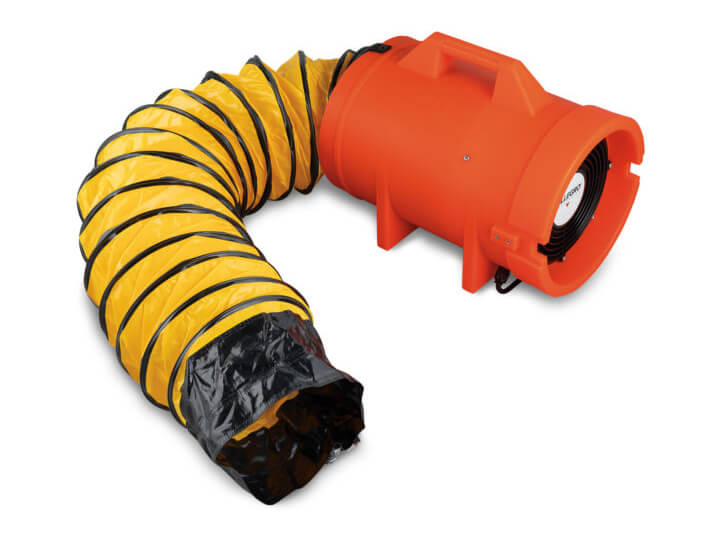
Source: Allegro Official Website
(https://www.allegrosafety.com/product/8-axial-ac-plastic-mini-pak-blower/)
(https://www.allegrosafety.com/product/8-axial-ac-plastic-mini-pak-blower/)
Rapidly exhausts dust/smoke replacing approx. 23.5m³ of air/min (*2). Lightweight polyethylene body is corrosion, UV, and chemical resistant for harsh environments.
Weighs under 19 lbs (lighter than steel) with integrated ducting. Easy to carry and set up, ensuring ventilation protocols are never skipped due to hassle.
| Type | Portable ventilation blower |
|---|---|
| Dimensions (in/mm) |
Approx. 17.5" × 11.3" × 13.5" (445 × 286 × 343 mm) |
| Coverage Area |
N/A |
| Weight | Approx. 19 lb |
Ventilation
For Stagnant Air and Moisture Control
For Stagnant Air and Moisture Control
DuctSox
ZOO FANS H series
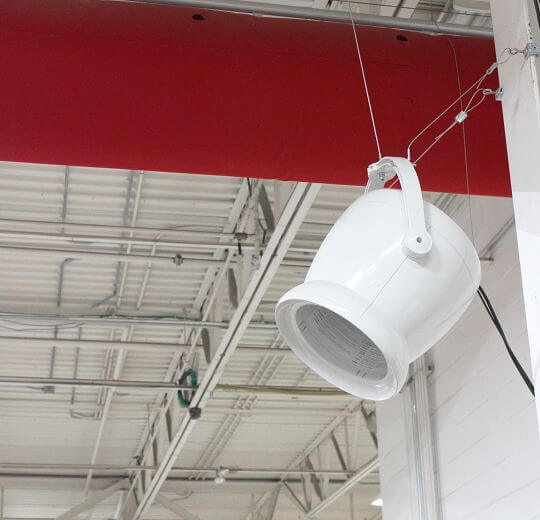
Source: DuctSox Official Website
(https://www.zoofans.com/our-company)
(https://www.zoofans.com/our-company)
Designed by spatial volume, not floor area. Creates a column of air mixing ceiling to floor to inhibit condensation, mold, and rust.
Includes one-touch mounting hardware. Low-cost installation even in warehouses where large HVLS fans won't fit.
| Type | Destratification Fan |
|---|---|
| Size (mm) | 445×391×551 (*3) |
| Coverage | 25 ft (*3) |
| Weight | 20 lb (*3) |
*1 Cool air temperature may vary depending on conditions such as ambient temperature and the surrounding environment. Because it uses water, use caution in areas where moisture is a concern.
*2 Basis and Calculation Method: Calculated based on the maximum airflow (Straight) of “791 CFM” for the “8" (20.3 cm) AXIAL AC PLASTIC MINI-PAK BLOWER (9532-15)” as listed in the catalog.
[Formula] 791 CFM × 0.02832 ≈ 22.4 m³/min (Converted as 1 CFM ≈ 0.02832 m³/min) | Source: Allegro Official Website [PDF] (https://www.allegrosafety.com/wp-content/uploads/2023/01/9532-15-9532-25-9532-15E-9532-25E-AC-Plastic-Blower.pdf)
*3 All specifications are for the H25-EC model.