
ProWork Fan Lab » Industrial Fans by Location » The Role of Industrial Fans in Warehouse Environments
The Role of Industrial Fans in Warehouse Environments
Index
When considering the installation of industrial fans in warehouses, this article explains their role, how they can be used, the differences between product types, and the key points to consider when selecting one, based on the characteristics of warehouse environments.
Role of Industrial Fans in Warehouses
The role of industrial fans in warehouses can be broadly divided into three categories: “airflow,” “ventilation,” and “air circulation.” Airflow helps lower the perceived temperature around employees, while ventilation helps disperse trapped heat and humidity. Furthermore, improving air circulation can help reduce temperature variations between different heights and areas.
Moving air improves comfort in the work environment, which helps workers stay focused and supports more consistent productivity.
Environmental Characteristics and
Challenges of Warehouses
The main reasons warehouses tend to get hot lie in their structural characteristics. Because ceilings are high, warm air tends to accumulate near the top, creating temperature differences between upper and lower areas.
In addition, insufficient airflow across a large floor area can allow heat to build up more easily. Frequent opening and closing of loading dock doors is another factor that reduces air conditioning efficiency. In environments where air tends to stagnate, it can be difficult to manage temperature with air conditioning alone, so considering the installation of industrial fans to support airflow can be effective.
How Industrial Fans Are Used
in Warehouses
How industrial fans are used varies depending on the installation purpose and work environment. Installing them permanently near the ceiling to circulate air throughout the warehouse is effective for reducing temperature variations in large spaces. On the other hand, in work areas where people gather, such as loading and inspection areas, providing targeted airflow can improve comfort for employees.
Furthermore, adapting how industrial fans are used according to the season and the type of work, such as operating them more intensively during the hottest periods of summer or timing their use to physically demanding tasks, is also an effective approach to heat stress prevention.
Types of Industrial Fans
Suitable for Warehouses
To serve these roles, product types can be broadly divided into two categories. One type moves air throughout the entire space, while the other provides airflow to specific areas. A typical example is an HVLS industrial fan, which is installed on the ceiling and circulates a large volume of air at low speed to help reduce temperature variations in large warehouses with high ceilings.
On the other hand, large fan products are often used as floor-mounted or portable units for targeted airflow in loading areas and other work areas where activity is concentrated. The key is to choose the product type based on whether the priority is improving the overall warehouse environment or improving employee comfort.
Key Points When Selecting
Warehouse Industrial Fans
When selecting a warehouse industrial fan, the first step is to check the space conditions. The size of the warehouse, the ceiling height, and the layout of beams and racks can significantly affect which types can be installed and how airflow reaches the space. The next point to consider is the usage conditions, including the type of work involved, such as picking and loading, and whether the fan will be operated continuously for long periods or used only during specific times.
In addition, check safety factors such as fall prevention during installation and maintaining clear traffic flow, as well as operational factors such as ease of cleaning and inspection, and also check for uneven heat across the site. Considering these factors comprehensively helps support a smooth installation process.
Explore Other
Industrial Fan Locations
Depending on the installation location, such as factories and gymnasiums as well as warehouses, the most suitable benefits will differ. Reviewing how to choose the right fan for each installation environment can lead to a more effective installation. If you are considering installing industrial fans in locations other than warehouses, see below.
Summary of Industrial Fans for Warehouses
Optimizing Airflow for High Ceilings and Large Storage Areas
Industrial fans are a practical solution for warehouses to reduce temperature variations caused by high ceilings and open loading docks. By selecting between HVLS fans for overall circulation or portable units for spot cooling, facilities can maintain consistent productivity even in expansive environments.
Our media independently researches and introduces recommended industrial fans based on specific needs like cooling, exhaust, and ventilation. Please check our 3 selected products below.
Three Recommended
Industrial Fan Products Chosen
by Cooling, Exhaust, and Ventilation
Industrial Fan Products Chosen
by Cooling, Exhaust, and Ventilation
Cooling
For Heat Stress Prevention
For Heat Stress Prevention
Gojoh
COOL FAN MIST
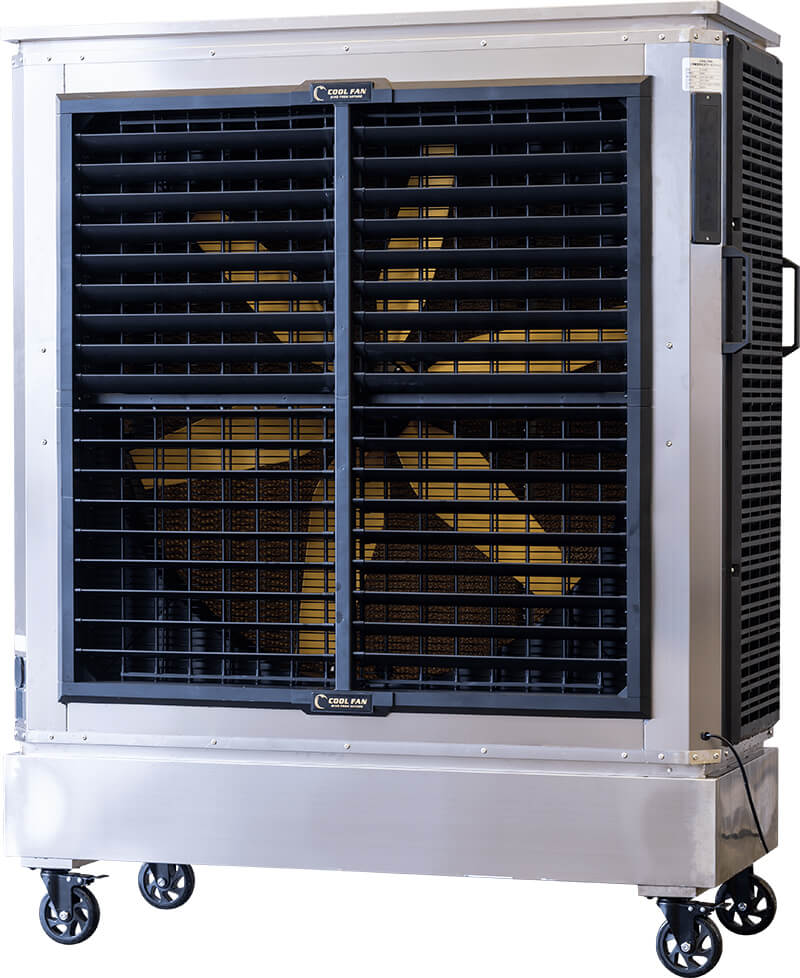
Source: Gojoh Official Website
(https://smile-fans.jp/products/cool-fan-mist/)
(https://smile-fans.jp/products/cool-fan-mist/)
6°C cooler than the surroundings (*1) for 8 hours. Powerful 25m reach + auto-swing to optimize your entire workspace.
Durable, hygienic stainless steel at a portable 210 lbs. Chemical-resistant and built for frequent relocation and long-term use.
| Type | Evaporative cooler |
|---|---|
| Dimensions (in/mm) |
Approx. 59.1" × 25.6" × 70.9" (1500 × 650 × 1800 mm) |
| Coverage Area |
Approx. 2,150–3,230 sq ft |
| Weight | Approx. 210 lb |
Exhaust
For Dust and Smoke Control in Confined Spaces
For Dust and Smoke Control in Confined Spaces
Allegro
8" COM-PAX-IAL Blower
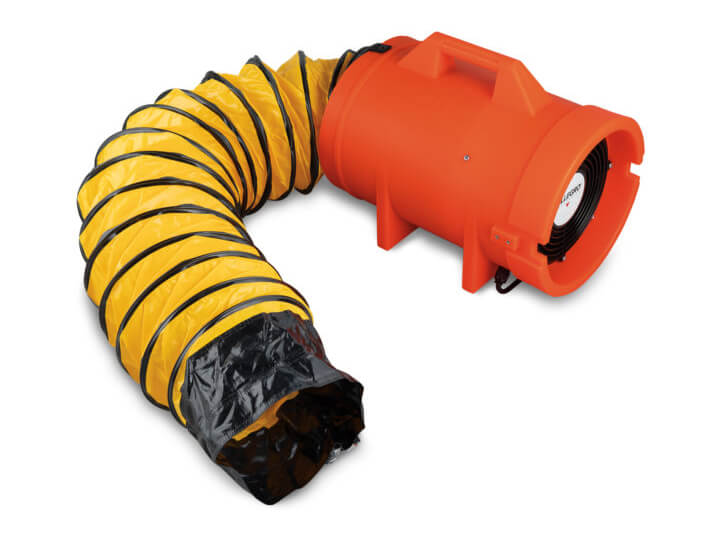
Source: Allegro Official Website
(https://www.allegrosafety.com/product/8-axial-ac-plastic-mini-pak-blower/)
(https://www.allegrosafety.com/product/8-axial-ac-plastic-mini-pak-blower/)
Rapidly exhausts dust/smoke replacing approx. 23.5m³ of air/min (*2). Lightweight polyethylene body is corrosion, UV, and chemical resistant for harsh environments.
Weighs under 19 lbs (lighter than steel) with integrated ducting. Easy to carry and set up, ensuring ventilation protocols are never skipped due to hassle.
| Type | Portable ventilation blower |
|---|---|
| Dimensions (in/mm) |
Approx. 17.5" × 11.3" × 13.5" (445 × 286 × 343 mm) |
| Coverage Area |
N/A |
| Weight | Approx. 19 lb |
Ventilation
For Stagnant Air and Moisture Control
For Stagnant Air and Moisture Control
DuctSox
ZOO FANS H series
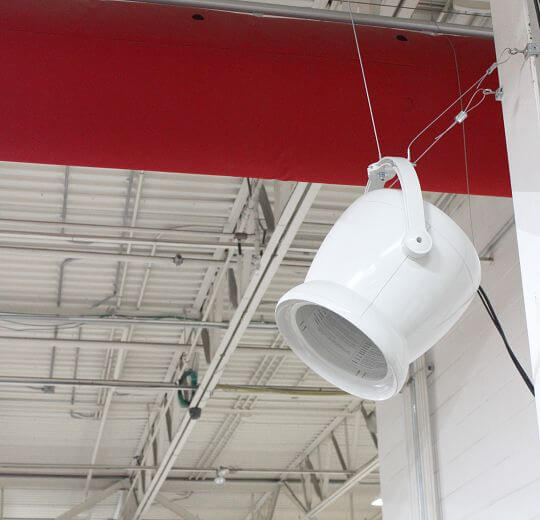
Source: DuctSox Official Website
(https://www.zoofans.com/our-company)
(https://www.zoofans.com/our-company)
Designed by spatial volume, not floor area. Creates a column of air mixing ceiling to floor to inhibit condensation, mold, and rust.
Includes one-touch mounting hardware. Low-cost installation even in warehouses where large HVLS fans won't fit.
| Type | Destratification Fan |
|---|---|
| Size (mm) | 445×391×551 (*3) |
| Coverage | 25 ft (*3) |
| Weight | 20 lb (*3) |
*1 Cool air temperature may vary depending on conditions such as ambient temperature and the surrounding environment. Because it uses water, use caution in areas where moisture is a concern.
*2 Basis and Calculation Method: Calculated based on the maximum airflow (Straight) of “791 CFM” for the “8" (20.3 cm) AXIAL AC PLASTIC MINI-PAK BLOWER (9532-15)” as listed in the catalog.
[Formula] 791 CFM × 0.02832 ≈ 22.4 m³/min (Converted as 1 CFM ≈ 0.02832 m³/min) | Source: Allegro Official Website [PDF] (https://www.allegrosafety.com/wp-content/uploads/2023/01/9532-15-9532-25-9532-15E-9532-25E-AC-Plastic-Blower.pdf)
*3 All specifications are for the H25-EC model.
*2 Basis and Calculation Method: Calculated based on the maximum airflow (Straight) of “791 CFM” for the “8" (20.3 cm) AXIAL AC PLASTIC MINI-PAK BLOWER (9532-15)” as listed in the catalog.
[Formula] 791 CFM × 0.02832 ≈ 22.4 m³/min (Converted as 1 CFM ≈ 0.02832 m³/min) | Source: Allegro Official Website [PDF] (https://www.allegrosafety.com/wp-content/uploads/2023/01/9532-15-9532-25-9532-15E-9532-25E-AC-Plastic-Blower.pdf)
*3 All specifications are for the H25-EC model.